Loan Rejection & Advisory
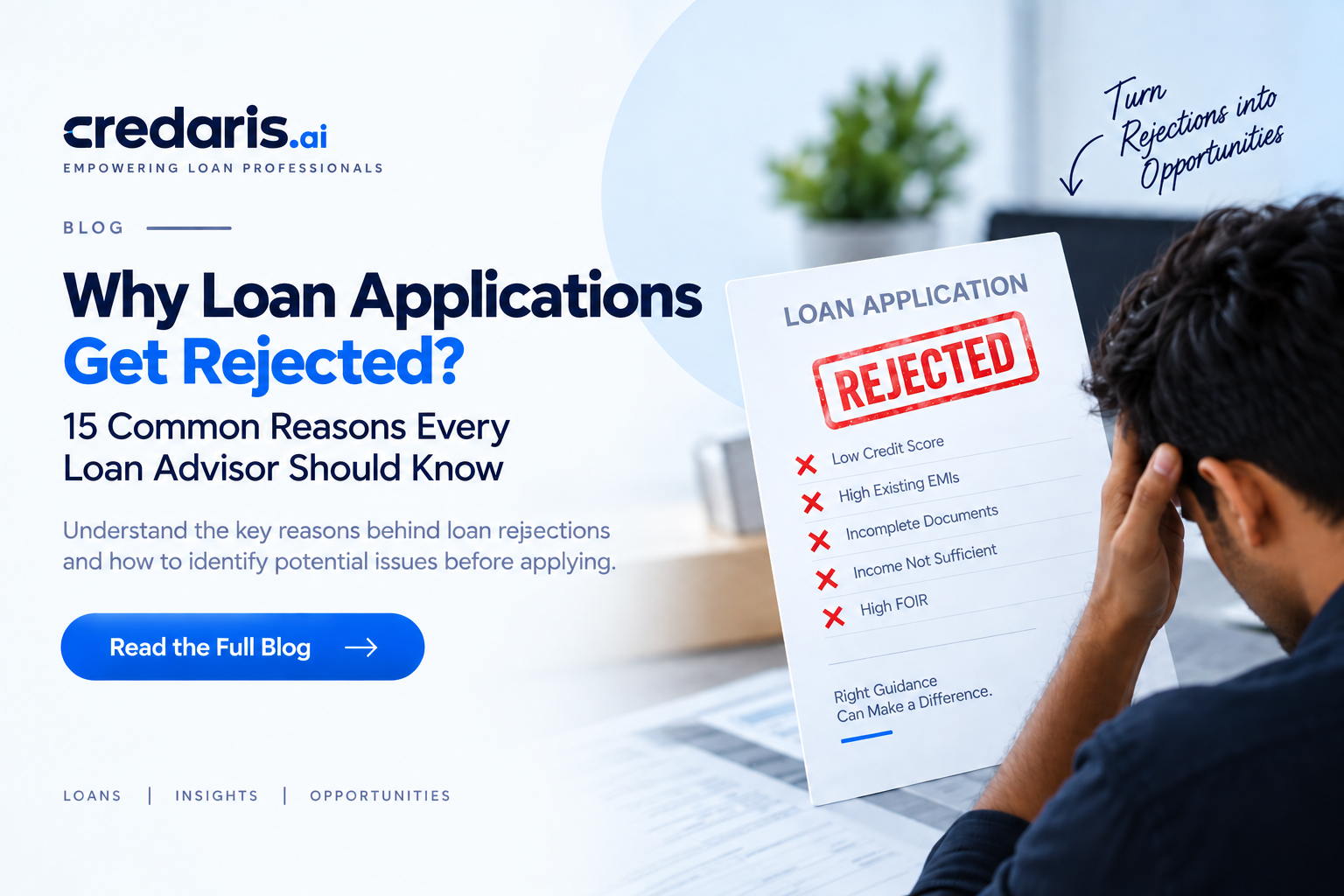
Why Loan Applications Get Rejected: 15 Common Reasons Every Loan Advisor Should Know
September 9, 2026 · ~9 min read
Loan rejection can happen for several reasons, from a weak credit profile and high existing obligations to incomplete documentation and unstable income. Here are 15 common reasons every loan advisor should understand
Credaris Insights
A loan rejection can be frustrating for both the customer and the loan advisor.
Customers often assume that having a good income or a regular job should be enough to get a loan. However, lenders evaluate several factors before making a lending decision. Even a customer who appears financially strong at first glance may face rejection if certain aspects of their profile do not meet the lender's criteria.
For loan advisors, understanding the common reasons behind loan rejection is extremely important. It allows them to identify potential issues early, set realistic expectations, and approach suitable lenders based on the customer's profile.
Here are 15 common reasons why loan applications may be rejected.
1. Low or Weak Credit Score
A customer's credit score is one of the factors lenders may consider when assessing a loan application.
A low credit score can indicate past repayment difficulties or other credit-related concerns. Depending on the lender's policies, this may reduce the customer's chances of approval or result in stricter lending terms.
Advisors should review the customer's credit profile before recommending a loan rather than assuming that income alone will be sufficient.
2. Poor Repayment History
A customer may have a reasonable credit score but still have issues in their repayment history.
Missed EMI payments, delayed credit card payments, overdue accounts, or defaults can negatively affect how lenders view the customer's credit behaviour.
Before submitting an application, advisors should understand whether the customer has any significant repayment issues in their credit history.
3. High FOIR
FOIR, or Fixed Obligation to Income Ratio, helps lenders understand how much of a customer's income is already committed towards financial obligations.
For example, a customer earning ?1,00,000 per month but already paying ?60,000 in eligible monthly obligations may have limited capacity for another loan.
If the proposed loan increases the customer's obligations beyond the lender's acceptable range, the application may face difficulties.
The acceptable FOIR varies between lenders and loan products.
4. High Existing Debt
Customers who already have multiple loans may have a higher overall debt burden.
A lender may consider existing home loans, personal loans, car loans, credit card obligations, and other eligible liabilities when assessing repayment capacity.
Even if the customer's income is strong, a high level of existing debt can affect their eligibility for additional borrowing.
5. Insufficient or Unstable Income
Lenders generally need confidence that the customer has sufficient and sustainable income to repay the proposed loan.
For salaried applicants, factors such as employment stability and salary consistency may be considered.
For self-employed applicants, lenders may evaluate business income, profitability, banking activity, and financial records.
If income is insufficient, inconsistent, or difficult to verify, the application may face additional scrutiny or rejection.
6. Unstable Employment History
Frequent job changes or a very short period with the current employer may affect eligibility depending on the lender's criteria.
Lenders may prefer customers who demonstrate a reasonable level of employment stability.
This does not mean that changing jobs automatically results in rejection. The impact depends on the lender, industry, income, and overall customer profile.
7. Incomplete Documentation
Documentation plays an important role in loan processing.
If required documents are missing, outdated, unclear, or inconsistent, the lender may not be able to properly verify the customer's information.
Common documents can include salary slips, bank statements, Form 16, Income Tax Returns, GST records, business documents, and identity or address proofs, depending on the loan type.
Advisors should ensure that the required documents are properly organised before submitting the application.
8. Mismatch in Information
Inconsistencies between documents can create concerns during verification.
For example, the income stated in an application may not match the income reflected in bank statements or tax documents.
Similarly, differences in employment details, business information, address, or existing liabilities may lead to additional verification.
Advisors should review customer information carefully before submission.
9. Too Many Recent Credit Enquiries
A customer who applies for several loans or credit cards within a short period may generate multiple credit enquiries.
Frequent enquiries can become part of the customer's credit profile and may be considered by lenders during assessment.
This does not automatically result in rejection, but unnecessary applications should generally be avoided.
10. Negative Banking Behaviour
Bank statements can provide lenders with valuable information about a customer's financial behaviour.
Frequent cheque bounces, irregular income credits, persistent negative balances, or other concerning patterns may affect the assessment.
The exact factors considered vary between lenders, but consistent and healthy banking activity can make it easier to understand the customer's financial position.
11. Unstable Business Income
Self-employed customers may face additional scrutiny because business income can fluctuate.
A lender may review business vintage, turnover, profitability, tax returns, GST records, bank statements, and other financial information.
If the business has inconsistent income or insufficient financial documentation, the application may become more difficult to process.
12. Customer Does Not Meet Lender-Specific Criteria
Every lender has its own eligibility requirements.
A customer may meet the general requirements for a loan but fail to meet a particular lender's internal criteria.
Requirements can differ based on income, age, employment type, location, business vintage, credit profile, loan amount, and other factors.
This is why loan advisors should understand multiple lender policies instead of assuming that every lender evaluates customers in the same way.
13. Incorrect Loan Product Selection
Sometimes the problem is not necessarily the customer but the product being recommended.
For example, a customer looking for business funding may be submitted under a product that does not appropriately match their business profile or requirement.
Understanding the customer's purpose, income structure, documentation, and financial position is essential when selecting a loan product.
The right product can make the application process more relevant and efficient.
14. Requested Loan Amount Is Too High
A customer may request an amount that does not align with their income, repayment capacity, credit profile, or available collateral.
Even when the customer has a legitimate requirement, the requested amount may exceed what the lender considers appropriate.
Advisors should therefore assess the customer's actual requirement and repayment capacity before deciding how much financing to seek.
15. Issues With Existing Credit Accounts
Existing credit accounts can sometimes create complications during loan assessment.
Outstanding dues, settlements, write-offs, overdue balances, or unresolved accounts may negatively affect the customer's profile.
Advisors should identify such issues before submitting an application and ensure that the customer understands how these factors may affect their borrowing options.
How Loan Advisors Can Reduce the Risk of Rejection
Loan rejection cannot always be prevented because the final decision belongs to the lender. However, advisors can improve the quality of applications by performing a proper preliminary assessment.
1. Understand the Customer Completely
Before recommending a product, the advisor should understand the customer's income, employment or business profile, existing obligations, credit history, loan requirement, and documentation.
2. Check Credit Information Early
Reviewing the customer's credit profile before application can help identify potential concerns.
This allows the advisor to have a more transparent discussion with the customer instead of discovering major issues after submission.
3. Calculate Repayment Capacity
Income should always be considered alongside existing financial obligations.
Understanding FOIR and other affordability measures can help advisors estimate whether the proposed EMI is realistic.
4. Match the Customer With the Right Lender
Different lenders have different policies.
A customer who does not meet one lender's criteria may potentially qualify with another lender whose requirements better match their profile.
However, advisors should recommend lenders based on genuine suitability rather than encouraging customers to submit applications everywhere.
5. Verify Documentation
Before submitting the application, advisors should check whether the customer's documents are complete, accurate, and consistent.
This can reduce avoidable delays and questions during verification.
What Should an Advisor Tell a Customer After Rejection?
Loan rejection can be sensitive for customers.
Instead of simply saying that the customer was rejected, an advisor should explain the situation clearly and professionally.
The advisor can explain that the lender's decision may have been based on one or several aspects of the customer's profile and that the next step is to understand the reason before considering other options.
Customers should not be encouraged to immediately submit multiple applications without understanding why the first application was unsuccessful.
Conclusion
Loan applications can be rejected for many reasons.
A weak credit profile, high FOIR, existing debt, unstable income, incomplete documentation, multiple recent enquiries, banking issues, or lender-specific criteria can all influence the outcome.
For loan advisors, the key is to identify potential issues before submitting an application.
A thorough customer assessment can help advisors recommend more suitable products, approach relevant lenders, and set realistic expectations with customers.
Most importantly, loan advisory should not be about submitting as many applications as possible. It should be about understanding the customer and finding a suitable lending option based on their financial profile.
Frequently Asked Questions
What is the most common reason for loan rejection?
There is no single reason that applies to every application. Credit history, high existing obligations, insufficient income, documentation issues, and lender-specific eligibility criteria can all contribute to rejection.
Can a loan be rejected despite a good CIBIL Score?
Yes. A good CIBIL Score does not guarantee approval. Lenders can also consider income, FOIR, existing debt, employment or business stability, documentation, and other factors.
Does high FOIR affect loan approval?
Yes. A high FOIR can indicate that a significant portion of the customer's income is already committed to existing obligations. The impact depends on the lender's criteria.
Can a rejected loan application be approved by another lender?
Possibly. Different lenders have different eligibility criteria and risk assessment policies. However, advisors should first understand the reason for rejection before approaching another lender.
Does applying to multiple lenders affect a customer's credit profile?
Multiple recent credit enquiries may become part of the customer's credit profile and can be considered by lenders. Customers should avoid unnecessary applications.
What should loan advisors check before submitting an application?
Advisors should review the customer's income, existing obligations, credit profile, employment or business stability, documentation, loan requirement, and lender-specific eligibility criteria.
Customers often assume that having a good income or a regular job should be enough to get a loan. However, lenders evaluate several factors before making a lending decision. Even a customer who appears financially strong at first glance may face rejection if certain aspects of their profile do not meet the lender's criteria.
For loan advisors, understanding the common reasons behind loan rejection is extremely important. It allows them to identify potential issues early, set realistic expectations, and approach suitable lenders based on the customer's profile.
Here are 15 common reasons why loan applications may be rejected.
1. Low or Weak Credit Score
A customer's credit score is one of the factors lenders may consider when assessing a loan application.
A low credit score can indicate past repayment difficulties or other credit-related concerns. Depending on the lender's policies, this may reduce the customer's chances of approval or result in stricter lending terms.
Advisors should review the customer's credit profile before recommending a loan rather than assuming that income alone will be sufficient.
2. Poor Repayment History
A customer may have a reasonable credit score but still have issues in their repayment history.
Missed EMI payments, delayed credit card payments, overdue accounts, or defaults can negatively affect how lenders view the customer's credit behaviour.
Before submitting an application, advisors should understand whether the customer has any significant repayment issues in their credit history.
3. High FOIR
FOIR, or Fixed Obligation to Income Ratio, helps lenders understand how much of a customer's income is already committed towards financial obligations.
For example, a customer earning ?1,00,000 per month but already paying ?60,000 in eligible monthly obligations may have limited capacity for another loan.
If the proposed loan increases the customer's obligations beyond the lender's acceptable range, the application may face difficulties.
The acceptable FOIR varies between lenders and loan products.
4. High Existing Debt
Customers who already have multiple loans may have a higher overall debt burden.
A lender may consider existing home loans, personal loans, car loans, credit card obligations, and other eligible liabilities when assessing repayment capacity.
Even if the customer's income is strong, a high level of existing debt can affect their eligibility for additional borrowing.
5. Insufficient or Unstable Income
Lenders generally need confidence that the customer has sufficient and sustainable income to repay the proposed loan.
For salaried applicants, factors such as employment stability and salary consistency may be considered.
For self-employed applicants, lenders may evaluate business income, profitability, banking activity, and financial records.
If income is insufficient, inconsistent, or difficult to verify, the application may face additional scrutiny or rejection.
6. Unstable Employment History
Frequent job changes or a very short period with the current employer may affect eligibility depending on the lender's criteria.
Lenders may prefer customers who demonstrate a reasonable level of employment stability.
This does not mean that changing jobs automatically results in rejection. The impact depends on the lender, industry, income, and overall customer profile.
7. Incomplete Documentation
Documentation plays an important role in loan processing.
If required documents are missing, outdated, unclear, or inconsistent, the lender may not be able to properly verify the customer's information.
Common documents can include salary slips, bank statements, Form 16, Income Tax Returns, GST records, business documents, and identity or address proofs, depending on the loan type.
Advisors should ensure that the required documents are properly organised before submitting the application.
8. Mismatch in Information
Inconsistencies between documents can create concerns during verification.
For example, the income stated in an application may not match the income reflected in bank statements or tax documents.
Similarly, differences in employment details, business information, address, or existing liabilities may lead to additional verification.
Advisors should review customer information carefully before submission.
9. Too Many Recent Credit Enquiries
A customer who applies for several loans or credit cards within a short period may generate multiple credit enquiries.
Frequent enquiries can become part of the customer's credit profile and may be considered by lenders during assessment.
This does not automatically result in rejection, but unnecessary applications should generally be avoided.
10. Negative Banking Behaviour
Bank statements can provide lenders with valuable information about a customer's financial behaviour.
Frequent cheque bounces, irregular income credits, persistent negative balances, or other concerning patterns may affect the assessment.
The exact factors considered vary between lenders, but consistent and healthy banking activity can make it easier to understand the customer's financial position.
11. Unstable Business Income
Self-employed customers may face additional scrutiny because business income can fluctuate.
A lender may review business vintage, turnover, profitability, tax returns, GST records, bank statements, and other financial information.
If the business has inconsistent income or insufficient financial documentation, the application may become more difficult to process.
12. Customer Does Not Meet Lender-Specific Criteria
Every lender has its own eligibility requirements.
A customer may meet the general requirements for a loan but fail to meet a particular lender's internal criteria.
Requirements can differ based on income, age, employment type, location, business vintage, credit profile, loan amount, and other factors.
This is why loan advisors should understand multiple lender policies instead of assuming that every lender evaluates customers in the same way.
13. Incorrect Loan Product Selection
Sometimes the problem is not necessarily the customer but the product being recommended.
For example, a customer looking for business funding may be submitted under a product that does not appropriately match their business profile or requirement.
Understanding the customer's purpose, income structure, documentation, and financial position is essential when selecting a loan product.
The right product can make the application process more relevant and efficient.
14. Requested Loan Amount Is Too High
A customer may request an amount that does not align with their income, repayment capacity, credit profile, or available collateral.
Even when the customer has a legitimate requirement, the requested amount may exceed what the lender considers appropriate.
Advisors should therefore assess the customer's actual requirement and repayment capacity before deciding how much financing to seek.
15. Issues With Existing Credit Accounts
Existing credit accounts can sometimes create complications during loan assessment.
Outstanding dues, settlements, write-offs, overdue balances, or unresolved accounts may negatively affect the customer's profile.
Advisors should identify such issues before submitting an application and ensure that the customer understands how these factors may affect their borrowing options.
How Loan Advisors Can Reduce the Risk of Rejection
Loan rejection cannot always be prevented because the final decision belongs to the lender. However, advisors can improve the quality of applications by performing a proper preliminary assessment.
1. Understand the Customer Completely
Before recommending a product, the advisor should understand the customer's income, employment or business profile, existing obligations, credit history, loan requirement, and documentation.
2. Check Credit Information Early
Reviewing the customer's credit profile before application can help identify potential concerns.
This allows the advisor to have a more transparent discussion with the customer instead of discovering major issues after submission.
3. Calculate Repayment Capacity
Income should always be considered alongside existing financial obligations.
Understanding FOIR and other affordability measures can help advisors estimate whether the proposed EMI is realistic.
4. Match the Customer With the Right Lender
Different lenders have different policies.
A customer who does not meet one lender's criteria may potentially qualify with another lender whose requirements better match their profile.
However, advisors should recommend lenders based on genuine suitability rather than encouraging customers to submit applications everywhere.
5. Verify Documentation
Before submitting the application, advisors should check whether the customer's documents are complete, accurate, and consistent.
This can reduce avoidable delays and questions during verification.
What Should an Advisor Tell a Customer After Rejection?
Loan rejection can be sensitive for customers.
Instead of simply saying that the customer was rejected, an advisor should explain the situation clearly and professionally.
The advisor can explain that the lender's decision may have been based on one or several aspects of the customer's profile and that the next step is to understand the reason before considering other options.
Customers should not be encouraged to immediately submit multiple applications without understanding why the first application was unsuccessful.
Conclusion
Loan applications can be rejected for many reasons.
A weak credit profile, high FOIR, existing debt, unstable income, incomplete documentation, multiple recent enquiries, banking issues, or lender-specific criteria can all influence the outcome.
For loan advisors, the key is to identify potential issues before submitting an application.
A thorough customer assessment can help advisors recommend more suitable products, approach relevant lenders, and set realistic expectations with customers.
Most importantly, loan advisory should not be about submitting as many applications as possible. It should be about understanding the customer and finding a suitable lending option based on their financial profile.
Frequently Asked Questions
What is the most common reason for loan rejection?
There is no single reason that applies to every application. Credit history, high existing obligations, insufficient income, documentation issues, and lender-specific eligibility criteria can all contribute to rejection.
Can a loan be rejected despite a good CIBIL Score?
Yes. A good CIBIL Score does not guarantee approval. Lenders can also consider income, FOIR, existing debt, employment or business stability, documentation, and other factors.
Does high FOIR affect loan approval?
Yes. A high FOIR can indicate that a significant portion of the customer's income is already committed to existing obligations. The impact depends on the lender's criteria.
Can a rejected loan application be approved by another lender?
Possibly. Different lenders have different eligibility criteria and risk assessment policies. However, advisors should first understand the reason for rejection before approaching another lender.
Does applying to multiple lenders affect a customer's credit profile?
Multiple recent credit enquiries may become part of the customer's credit profile and can be considered by lenders. Customers should avoid unnecessary applications.
What should loan advisors check before submitting an application?
Advisors should review the customer's income, existing obligations, credit profile, employment or business stability, documentation, loan requirement, and lender-specific eligibility criteria.
Share
Insights for regulated credit and distribution teams.