Loan Eligibility & Advisory
How Banks Assess a Customer’s Loan Eligibility
September 3, 2026 · ~10 min read
Loan Eligibility & Advisory
Credaris Insights
When a customer approaches a loan advisor, one of the first questions they usually ask is simple:
“How much loan can I get?”
The answer, however, is rarely based on income alone.
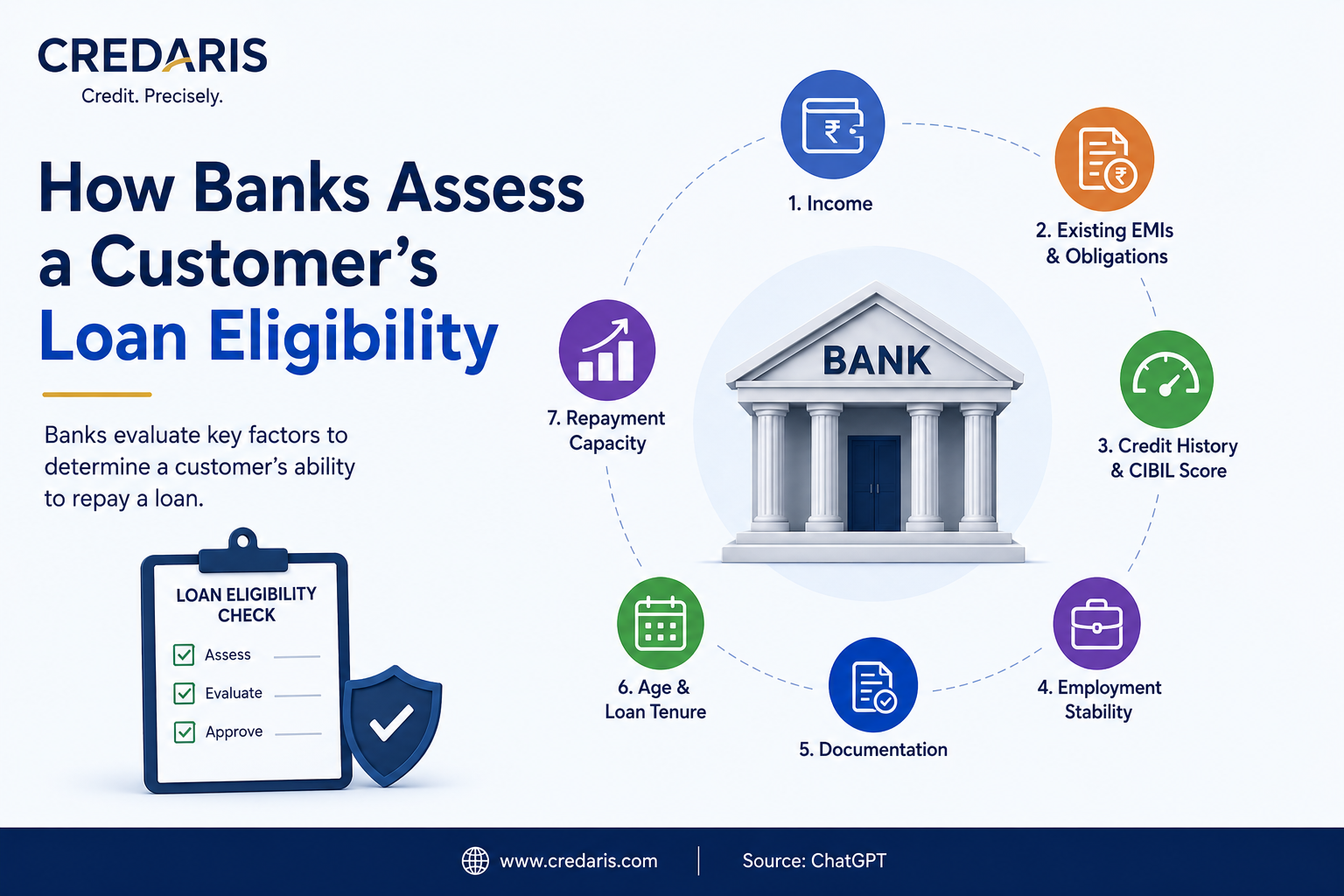
Banks and financial institutions evaluate multiple aspects of a customer's financial profile before deciding whether to approve a loan. They look at the customer's income, existing obligations, credit history, employment or business stability, banking behaviour, documentation, and the type of loan being requested.
For loan advisors, understanding this process is extremely important. It helps them assess customers more accurately, set realistic expectations, and identify suitable lending options before submitting an application.
What Is Loan Eligibility?
Loan eligibility refers to a customer's ability to qualify for a particular loan based on the lender's eligibility criteria.
The criteria can differ depending on:
•Loan type
•Lender
•Customer profile
•Income
•Age
•Employment or business profile
•Existing financial obligations
•Credit history
•Loan amount
•Loan tenure
•Documentation
There is no single formula that applies to every lender.
A customer who may not qualify for one lender's product could potentially qualify with another lender because lending policies and risk assessment methods can differ.
1. Monthly Income
Income is one of the first factors lenders consider.
For salaried customers, lenders may evaluate the customer's regular salary and supporting income documents.
For self-employed customers, lenders may assess business income through financial statements, tax returns, bank statements, and other relevant documentation.
A higher stable income can generally support a higher repayment capacity, but income by itself does not guarantee approval.
Lenders also consider how much of that income is already committed towards existing obligations.
2. Existing EMIs and Financial Obligations
A customer may earn a good income but already have multiple loans.
For example, a customer earning ?1,00,000 per month may already be paying:
Home loan EMI: ?30,000
Car loan EMI: ?15,000
Personal loan EMI: ?10,000
That means ?55,000 is already committed towards existing EMIs.
The lender therefore needs to determine whether the customer can comfortably take on another monthly obligation.
This is where concepts such as FOIR, or Fixed Obligation to Income Ratio, become important.
3. Credit History and CIBIL Score
Credit history provides lenders with information about how a customer has handled credit in the past.
Lenders may consider factors such as:
•Previous loans
•Repayment history
•Credit card payments
•Outstanding balances
•Defaults
•Settlements
•Credit utilisation
•Recent credit enquiries
A strong credit history can support a customer's loan application, while negative repayment behaviour can make approval more difficult.
However, there is no single CIBIL Score that guarantees approval or rejection. Lenders use their own credit policies and assess the customer's complete profile.
4. Employment Stability
For salaried applicants, lenders may consider employment stability as part of their assessment.
Factors can include:
•Current employer
•Employment type
•Length of employment
•Industry
•Salary consistency
•Recent job changes
A stable employment profile can provide greater confidence regarding future repayment capacity.
Frequent job changes or a short employment history may receive additional scrutiny depending on the lender's policies.
5. Business Stability for Self-Employed Applicants
Self-employed customers are assessed somewhat differently.
Because business income can fluctuate, lenders may look at the stability and continuity of the business.
Relevant factors can include:
•Business vintage
•Annual turnover
•Profitability
•Income Tax Returns
•GST records
•Banking transactions
•Financial statements
•Existing business liabilities
The objective is to understand whether the business generates sufficient and sustainable income to support loan repayment.
6. Banking Behaviour
A customer's bank statement can reveal useful information about their financial behaviour.
Lenders may look at factors such as:
•Regular income credits
•EMI payments
•Account balances
•Cheque returns
•Overdraft usage
•Unusual transactions
•Existing financial commitments
For salaried applicants, consistent salary credits can help establish income stability.
For business owners, banking activity can provide additional insight into business cash flow.
Banking behaviour is therefore an important part of understanding the customer's overall financial profile.
7. Debt-to-Income and FOIR
Lenders need to understand how much of a customer's income is already being used to service debt.
FOIR is one method that may be used to evaluate this.
A simplified calculation is:
FOIR = Total Relevant Monthly Obligations ÷ Monthly Income × 100
For example, if relevant monthly obligations are ?40,000 and monthly income is ?1,00,000:
FOIR = ?40,000 ÷ ?1,00,000 × 100 = 40%
The acceptable level can vary between lenders and loan products.
This is why advisors should avoid assuming that one FOIR threshold applies across the entire lending industry.
8. Age of the Customer
Age can also influence loan eligibility.
Lenders generally need to ensure that the loan can be repaid within their permitted tenure and age criteria.
A younger applicant may potentially have access to a longer repayment period, depending on the product.
For older applicants, the available tenure may be more restricted depending on the lender's policies.
The customer's age is therefore considered along with income, tenure, and overall repayment capacity.
9. Loan Amount and Tenure
The requested loan amount also affects eligibility.
A customer asking for a ?5 lakh loan may have a very different repayment requirement from someone seeking ?50 lakh.
Loan tenure also matters because it affects the EMI.
A longer tenure can reduce the monthly EMI, although it may increase the total interest paid over the duration of the loan.
Lenders assess whether the proposed loan amount and tenure are appropriate for the customer's financial profile.
10. Type of Loan
Loan eligibility also depends on the product being requested.
For example:
Personal Loan:
Usually relies heavily on factors such as income, employment, credit profile, and repayment capacity.
Home Loan:
Can involve income, credit history, property value, down payment, age, and repayment capacity.
Loan Against Property:
May consider property value, income, existing obligations, credit profile, and the purpose of the loan.
Business Loan:
Can involve business vintage, turnover, profitability, banking behaviour, tax records, and credit history.
This is why loan advisors should understand the customer's requirement before recommending a product.
11. Documentation
Proper documentation is essential for loan processing.
Depending on the loan and customer profile, lenders may request documents such as:
•Salaried Customers
•Salary slips
•Bank statements
•Form 16
•Income Tax documents
•Employment-related documents
•Self-Employed Customers
•Income Tax Returns
•GST returns
•Profit and loss statements
•Balance sheets
•Business registration documents
•Bank statements
The exact requirements vary between lenders and loan products.
Incomplete or inconsistent documentation can delay the application or create additional questions during underwriting.
12. Banking and Repayment Discipline
Repayment behaviour is particularly important.
Regularly paying EMIs and credit card bills on time can demonstrate responsible credit management.
On the other hand, repeated missed payments, cheque bounces, or unresolved overdue amounts can negatively affect the customer's credit profile and potentially impact loan eligibility.
Loan advisors should therefore encourage customers to maintain disciplined repayment behaviour.
13. Number of Recent Loan Applications
Multiple recent credit applications can also be relevant during credit assessment.
When a customer applies for several loans or credit products within a short period, lenders may see multiple credit enquiries on the customer's credit report.
This does not automatically mean the customer will be rejected. However, frequent applications can be one of the factors considered as part of the broader credit assessment.
Advisors should therefore avoid encouraging customers to apply indiscriminately to multiple lenders.
14. Stability of Financial Profile
Lenders generally prefer predictable and well-documented financial profiles.
For example, a customer with:
•Stable income
•Consistent banking activity
•Good repayment history
•Manageable obligations
•Proper documentation
may present a more straightforward profile for assessment.
The stronger and more consistent the financial information, the easier it can be for the lender to evaluate the customer's repayment capacity.
15. Lender-Specific Credit Policies
One of the most important things loan advisors should understand is that every lender may have different eligibility criteria.
Two lenders can receive the same customer profile and arrive at different decisions.
Factors such as acceptable income sources, FOIR limits, minimum credit requirements, employment criteria, business vintage, loan purpose, and documentation requirements can vary.
This makes lender-product knowledge extremely valuable for loan advisors.
How Loan Advisors Can Assess a Customer Before Application
Before submitting a loan application, advisors can create a basic customer profile.
A useful checklist can include:
Step 1: Understand the customer's loan requirement.
Step 2: Verify monthly income.
Step 3: Identify existing EMIs and financial obligations.
Step 4: Review credit history.
Step 5: Understand employment or business stability.
Step 6: Review banking behaviour.
Step 7: Check required documentation.
Step 8: Estimate repayment capacity.
Step 9: Identify potentially suitable lenders and products.
Step 10: Set realistic expectations with the customer.
This approach can help reduce unsuitable applications and make the overall advisory process more efficient.
Why Loan Advisors Should Avoid Guaranteeing Approval
A common mistake in loan sales is promising approval before the lender has completed its assessment.
Even when a customer appears eligible, the final decision can depend on detailed underwriting, document verification, internal credit policies, and other factors.
Instead of saying:
“Your loan will definitely be approved.”
an advisor can say:
“Based on the information available, your profile appears suitable for these options, subject to the lender's final assessment.”
This creates more realistic expectations and helps maintain customer trust.
How Technology Can Improve Loan Eligibility Assessment
Technology is making it easier for loan advisors to organise and evaluate customer information.
Digital tools can help advisors:
Organise customer profiles
Track financial information
Compare product criteria
Manage documents
Prioritise leads
Track application stages
Automate follow-ups
AI can further support these processes by helping advisors analyse information faster and reduce repetitive manual work.
The advisor still plays an important role in understanding the customer's circumstances and communicating the available options.
Conclusion
Loan eligibility is not determined by a single factor.
Banks and financial institutions can consider income, existing obligations, credit history, employment or business stability, banking behaviour, age, documentation, loan amount, tenure, and lender-specific policies when evaluating a customer.
For loan advisors, understanding these factors is essential for making better recommendations and setting realistic expectations.
The goal should not simply be to submit more applications. It should be to understand the customer properly, identify suitable options, and guide them through the lending process with greater clarity.
A well-informed loan advisor can help customers find not just a loan, but a loan that fits their financial profile.
Frequently Asked Questions
What factors do banks consider for loan eligibility?
Banks may consider income, credit history, existing EMIs, FOIR, employment or business stability, banking behaviour, age, documentation, loan amount, tenure, and their internal lending policies.
Does a high salary guarantee loan approval?
No. A high income does not guarantee approval. Existing obligations, credit history, employment stability, documentation, and other factors can also influence the lender's decision.
Does CIBIL Score affect loan eligibility?
Yes. Credit history and CIBIL Score can influence a lender's assessment, although the exact requirements vary between lenders and loan products.
Can a self-employed person get a loan?
Yes. Self-employed applicants can qualify for loans subject to the lender's eligibility criteria. Lenders may assess business income, financial statements, tax returns, banking activity, business vintage, and other factors.
Why can one bank reject a loan while another approves it?
Lenders have different credit policies and risk assessment methods. A customer who does not meet one lender's criteria may potentially qualify with another lender.
What should a loan advisor check before submitting an application?
An advisor should review the customer's income, existing obligations, credit history, employment or business profile, banking behaviour, documentation, loan requirement, and potential lender eligibility criteria before submitting the application.
“How much loan can I get?”
The answer, however, is rarely based on income alone.
Banks and financial institutions evaluate multiple aspects of a customer's financial profile before deciding whether to approve a loan. They look at the customer's income, existing obligations, credit history, employment or business stability, banking behaviour, documentation, and the type of loan being requested.
For loan advisors, understanding this process is extremely important. It helps them assess customers more accurately, set realistic expectations, and identify suitable lending options before submitting an application.
What Is Loan Eligibility?
Loan eligibility refers to a customer's ability to qualify for a particular loan based on the lender's eligibility criteria.
The criteria can differ depending on:
•Loan type
•Lender
•Customer profile
•Income
•Age
•Employment or business profile
•Existing financial obligations
•Credit history
•Loan amount
•Loan tenure
•Documentation
There is no single formula that applies to every lender.
A customer who may not qualify for one lender's product could potentially qualify with another lender because lending policies and risk assessment methods can differ.
1. Monthly Income
Income is one of the first factors lenders consider.
For salaried customers, lenders may evaluate the customer's regular salary and supporting income documents.
For self-employed customers, lenders may assess business income through financial statements, tax returns, bank statements, and other relevant documentation.
A higher stable income can generally support a higher repayment capacity, but income by itself does not guarantee approval.
Lenders also consider how much of that income is already committed towards existing obligations.
2. Existing EMIs and Financial Obligations
A customer may earn a good income but already have multiple loans.
For example, a customer earning ?1,00,000 per month may already be paying:
Home loan EMI: ?30,000
Car loan EMI: ?15,000
Personal loan EMI: ?10,000
That means ?55,000 is already committed towards existing EMIs.
The lender therefore needs to determine whether the customer can comfortably take on another monthly obligation.
This is where concepts such as FOIR, or Fixed Obligation to Income Ratio, become important.
3. Credit History and CIBIL Score
Credit history provides lenders with information about how a customer has handled credit in the past.
Lenders may consider factors such as:
•Previous loans
•Repayment history
•Credit card payments
•Outstanding balances
•Defaults
•Settlements
•Credit utilisation
•Recent credit enquiries
A strong credit history can support a customer's loan application, while negative repayment behaviour can make approval more difficult.
However, there is no single CIBIL Score that guarantees approval or rejection. Lenders use their own credit policies and assess the customer's complete profile.
4. Employment Stability
For salaried applicants, lenders may consider employment stability as part of their assessment.
Factors can include:
•Current employer
•Employment type
•Length of employment
•Industry
•Salary consistency
•Recent job changes
A stable employment profile can provide greater confidence regarding future repayment capacity.
Frequent job changes or a short employment history may receive additional scrutiny depending on the lender's policies.
5. Business Stability for Self-Employed Applicants
Self-employed customers are assessed somewhat differently.
Because business income can fluctuate, lenders may look at the stability and continuity of the business.
Relevant factors can include:
•Business vintage
•Annual turnover
•Profitability
•Income Tax Returns
•GST records
•Banking transactions
•Financial statements
•Existing business liabilities
The objective is to understand whether the business generates sufficient and sustainable income to support loan repayment.
6. Banking Behaviour
A customer's bank statement can reveal useful information about their financial behaviour.
Lenders may look at factors such as:
•Regular income credits
•EMI payments
•Account balances
•Cheque returns
•Overdraft usage
•Unusual transactions
•Existing financial commitments
For salaried applicants, consistent salary credits can help establish income stability.
For business owners, banking activity can provide additional insight into business cash flow.
Banking behaviour is therefore an important part of understanding the customer's overall financial profile.
7. Debt-to-Income and FOIR
Lenders need to understand how much of a customer's income is already being used to service debt.
FOIR is one method that may be used to evaluate this.
A simplified calculation is:
FOIR = Total Relevant Monthly Obligations ÷ Monthly Income × 100
For example, if relevant monthly obligations are ?40,000 and monthly income is ?1,00,000:
FOIR = ?40,000 ÷ ?1,00,000 × 100 = 40%
The acceptable level can vary between lenders and loan products.
This is why advisors should avoid assuming that one FOIR threshold applies across the entire lending industry.
8. Age of the Customer
Age can also influence loan eligibility.
Lenders generally need to ensure that the loan can be repaid within their permitted tenure and age criteria.
A younger applicant may potentially have access to a longer repayment period, depending on the product.
For older applicants, the available tenure may be more restricted depending on the lender's policies.
The customer's age is therefore considered along with income, tenure, and overall repayment capacity.
9. Loan Amount and Tenure
The requested loan amount also affects eligibility.
A customer asking for a ?5 lakh loan may have a very different repayment requirement from someone seeking ?50 lakh.
Loan tenure also matters because it affects the EMI.
A longer tenure can reduce the monthly EMI, although it may increase the total interest paid over the duration of the loan.
Lenders assess whether the proposed loan amount and tenure are appropriate for the customer's financial profile.
10. Type of Loan
Loan eligibility also depends on the product being requested.
For example:
Personal Loan:
Usually relies heavily on factors such as income, employment, credit profile, and repayment capacity.
Home Loan:
Can involve income, credit history, property value, down payment, age, and repayment capacity.
Loan Against Property:
May consider property value, income, existing obligations, credit profile, and the purpose of the loan.
Business Loan:
Can involve business vintage, turnover, profitability, banking behaviour, tax records, and credit history.
This is why loan advisors should understand the customer's requirement before recommending a product.
11. Documentation
Proper documentation is essential for loan processing.
Depending on the loan and customer profile, lenders may request documents such as:
•Salaried Customers
•Salary slips
•Bank statements
•Form 16
•Income Tax documents
•Employment-related documents
•Self-Employed Customers
•Income Tax Returns
•GST returns
•Profit and loss statements
•Balance sheets
•Business registration documents
•Bank statements
The exact requirements vary between lenders and loan products.
Incomplete or inconsistent documentation can delay the application or create additional questions during underwriting.
12. Banking and Repayment Discipline
Repayment behaviour is particularly important.
Regularly paying EMIs and credit card bills on time can demonstrate responsible credit management.
On the other hand, repeated missed payments, cheque bounces, or unresolved overdue amounts can negatively affect the customer's credit profile and potentially impact loan eligibility.
Loan advisors should therefore encourage customers to maintain disciplined repayment behaviour.
13. Number of Recent Loan Applications
Multiple recent credit applications can also be relevant during credit assessment.
When a customer applies for several loans or credit products within a short period, lenders may see multiple credit enquiries on the customer's credit report.
This does not automatically mean the customer will be rejected. However, frequent applications can be one of the factors considered as part of the broader credit assessment.
Advisors should therefore avoid encouraging customers to apply indiscriminately to multiple lenders.
14. Stability of Financial Profile
Lenders generally prefer predictable and well-documented financial profiles.
For example, a customer with:
•Stable income
•Consistent banking activity
•Good repayment history
•Manageable obligations
•Proper documentation
may present a more straightforward profile for assessment.
The stronger and more consistent the financial information, the easier it can be for the lender to evaluate the customer's repayment capacity.
15. Lender-Specific Credit Policies
One of the most important things loan advisors should understand is that every lender may have different eligibility criteria.
Two lenders can receive the same customer profile and arrive at different decisions.
Factors such as acceptable income sources, FOIR limits, minimum credit requirements, employment criteria, business vintage, loan purpose, and documentation requirements can vary.
This makes lender-product knowledge extremely valuable for loan advisors.
How Loan Advisors Can Assess a Customer Before Application
Before submitting a loan application, advisors can create a basic customer profile.
A useful checklist can include:
Step 1: Understand the customer's loan requirement.
Step 2: Verify monthly income.
Step 3: Identify existing EMIs and financial obligations.
Step 4: Review credit history.
Step 5: Understand employment or business stability.
Step 6: Review banking behaviour.
Step 7: Check required documentation.
Step 8: Estimate repayment capacity.
Step 9: Identify potentially suitable lenders and products.
Step 10: Set realistic expectations with the customer.
This approach can help reduce unsuitable applications and make the overall advisory process more efficient.
Why Loan Advisors Should Avoid Guaranteeing Approval
A common mistake in loan sales is promising approval before the lender has completed its assessment.
Even when a customer appears eligible, the final decision can depend on detailed underwriting, document verification, internal credit policies, and other factors.
Instead of saying:
“Your loan will definitely be approved.”
an advisor can say:
“Based on the information available, your profile appears suitable for these options, subject to the lender's final assessment.”
This creates more realistic expectations and helps maintain customer trust.
How Technology Can Improve Loan Eligibility Assessment
Technology is making it easier for loan advisors to organise and evaluate customer information.
Digital tools can help advisors:
Organise customer profiles
Track financial information
Compare product criteria
Manage documents
Prioritise leads
Track application stages
Automate follow-ups
AI can further support these processes by helping advisors analyse information faster and reduce repetitive manual work.
The advisor still plays an important role in understanding the customer's circumstances and communicating the available options.
Conclusion
Loan eligibility is not determined by a single factor.
Banks and financial institutions can consider income, existing obligations, credit history, employment or business stability, banking behaviour, age, documentation, loan amount, tenure, and lender-specific policies when evaluating a customer.
For loan advisors, understanding these factors is essential for making better recommendations and setting realistic expectations.
The goal should not simply be to submit more applications. It should be to understand the customer properly, identify suitable options, and guide them through the lending process with greater clarity.
A well-informed loan advisor can help customers find not just a loan, but a loan that fits their financial profile.
Frequently Asked Questions
What factors do banks consider for loan eligibility?
Banks may consider income, credit history, existing EMIs, FOIR, employment or business stability, banking behaviour, age, documentation, loan amount, tenure, and their internal lending policies.
Does a high salary guarantee loan approval?
No. A high income does not guarantee approval. Existing obligations, credit history, employment stability, documentation, and other factors can also influence the lender's decision.
Does CIBIL Score affect loan eligibility?
Yes. Credit history and CIBIL Score can influence a lender's assessment, although the exact requirements vary between lenders and loan products.
Can a self-employed person get a loan?
Yes. Self-employed applicants can qualify for loans subject to the lender's eligibility criteria. Lenders may assess business income, financial statements, tax returns, banking activity, business vintage, and other factors.
Why can one bank reject a loan while another approves it?
Lenders have different credit policies and risk assessment methods. A customer who does not meet one lender's criteria may potentially qualify with another lender.
What should a loan advisor check before submitting an application?
An advisor should review the customer's income, existing obligations, credit history, employment or business profile, banking behaviour, documentation, loan requirement, and potential lender eligibility criteria before submitting the application.
Share
Insights for regulated credit and distribution teams.