Loan Eligibility & Advisory
FOIR Explained: How Banks Decide Whether a Customer Can Afford a Loan
September 3, 2026 · ~8 min read
FOIR is an important factor lenders consider when evaluating a customer's ability to repay a loan. Learn how FOIR is calculated, what affects it, and how loan advisors can explain it clearly to customers.
Credaris Insights
When a customer applies for a loan, lenders look at more than just their income. They also want to understand how much of that income is already committed towards existing financial obligations.
This is where FOIR, or Fixed Obligation to Income Ratio, becomes important.
FOIR helps lenders assess whether a customer has enough monthly income available to comfortably manage a new loan along with their existing commitments.
For loan advisors, understanding FOIR is essential. It can help them assess customer profiles more effectively, identify potential eligibility issues early, and recommend suitable loan options.
What Is FOIR?
FOIR stands for Fixed Obligation to Income Ratio.
It represents the proportion of a customer's monthly income that is already committed towards fixed financial obligations, including existing loan EMIs and, depending on the lender's policy, other recurring obligations.
In simple terms, FOIR answers an important question:
"After paying existing obligations and the proposed loan EMI, will the customer still have sufficient income available?"
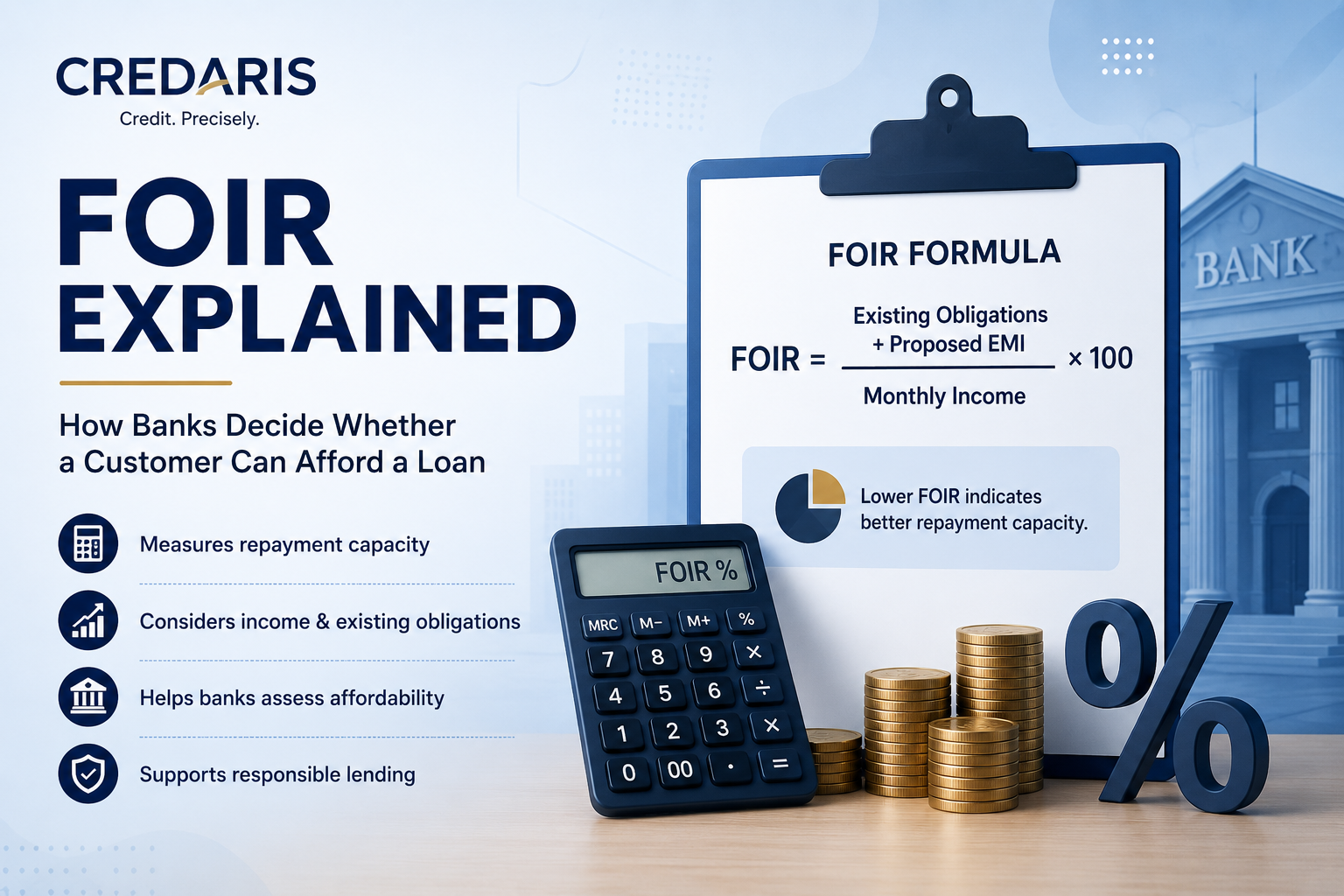
A lower FOIR generally indicates that the customer has more disposable income available to service additional debt.
How Is FOIR Calculated?
A commonly used formula is:
FOIR = (Existing Monthly Obligations + Proposed Loan EMI) ÷ Monthly Income × 100
For example, suppose a customer earns ?80,000 per month.
Their existing monthly obligations are ?15,000, and the proposed loan would add an EMI of ?20,000.
The calculation would be:
FOIR = (?15,000 + ?20,000) ÷ ?80,000 × 100
FOIR = 43.75%
This means approximately 43.75% of the customer's monthly income would be committed towards the relevant fixed obligations after taking the new loan.
The acceptable FOIR can vary depending on the lender, loan product, customer profile, income level, and other underwriting factors.
Why Do Banks Consider FOIR?
Lenders need to evaluate repayment capacity before approving a loan.
A customer may have a strong income, but if a significant portion of that income is already committed towards existing obligations, taking on another loan could increase repayment pressure.
FOIR gives lenders a structured way to evaluate this.
It helps them understand:
Existing debt burden
Potential repayment capacity
Available disposable income
Risk associated with additional borrowing
Whether the proposed EMI may be manageable
FOIR is therefore one of several factors that can contribute to a lender's overall credit assessment.
What Counts as a Fixed Obligation?
The exact obligations considered can differ between lenders and products.
Common examples may include:
Existing loan EMIs
Personal loan EMIs
Home loan EMIs
Car loan EMIs
Other recurring debt obligations
Proposed loan EMI
Some lenders may apply their own policies when determining which obligations are included in the calculation.
This is why loan advisors should always check the relevant lender's eligibility and underwriting guidelines rather than assuming that the same calculation applies everywhere.
FOIR Example for a Salaried Customer
Consider a customer with a monthly net income of ?1,00,000.
Their existing obligations include:
Home loan EMI: ?25,000
Car loan EMI: ?10,000
Other eligible obligations: ?5,000
The customer is applying for a new loan with an estimated EMI of ?15,000.
Total obligations:
?25,000 + ?10,000 + ?5,000 + ?15,000 = ?55,000
FOIR:
?55,000 ÷ ?1,00,000 × 100 = 55%
The customer's FOIR would therefore be 55% based on these figures.
Whether that profile qualifies would depend on the lender's specific criteria and the customer's broader financial profile.
FOIR for Self-Employed Customers
FOIR can also be relevant when assessing self-employed applicants.
However, evaluating income for self-employed customers can be more complex because their earnings may fluctuate and may need to be assessed using financial documents.
Depending on the lender and product, the assessment may involve information such as:
Income Tax Returns
Profit and loss statements
Business financial statements
Bank statements
GST-related records
Existing loan obligations
Loan advisors should understand that the income figure used by a lender may not always be identical to the customer's stated monthly business income.
How FOIR Affects Loan Eligibility
FOIR can have a direct impact on how much additional debt a customer may be able to take on.
For example, two customers may both earn ?1 lakh per month.
Customer A has existing obligations of ?10,000.
Customer B has existing obligations of ?45,000.
Even though their incomes are identical, their repayment capacity may look very different to a lender.
This is why simply looking at salary or business income is not enough when assessing loan eligibility.
What Happens When FOIR Is High?
A high FOIR indicates that a larger proportion of the customer's income is already committed towards financial obligations.
Depending on the lender's criteria, this may result in:
Lower eligible loan amount
Requirement for additional documentation
Higher scrutiny during underwriting
Requirement for a co-applicant in certain cases
Loan application rejection
However, a high FOIR does not automatically mean that every lender will reject the application.
Different lenders may have different credit policies and assessment methods.
How Can Customers Improve Their FOIR?
If a customer's FOIR is high, a loan advisor can explore practical ways to improve the overall profile.
1. Reduce Existing Debt
Closing or reducing certain existing loans can lower monthly obligations.
2. Consider a Suitable Loan Amount
A smaller loan amount generally means a lower proposed EMI, which can improve the overall obligation-to-income ratio.
3. Extend the Loan Tenure
In some cases, a longer tenure may reduce the monthly EMI. However, customers should also understand that extending tenure can increase the total interest paid over the life of the loan.
4. Improve Documented Income
For self-employed applicants especially, maintaining proper financial records and accurately documenting income can help lenders assess the profile more effectively.
5. Consider a Co-Applicant Where Appropriate
A co-applicant with eligible income may improve the overall repayment profile in certain loan structures, subject to the lender's policies.
FOIR vs CIBIL Score
FOIR and CIBIL Score serve different purposes.
FOIR primarily focuses on repayment capacity.
CIBIL Score primarily reflects credit history and credit behaviour.
A customer can have a good CIBIL Score but still face eligibility challenges if their existing financial obligations are high.
Similarly, a customer may have a manageable FOIR but a weaker credit history.
This is why lenders typically consider multiple factors instead of relying on a single metric.
What Loan Advisors Should Tell Customers
Loan advisors should explain FOIR in simple language instead of using complicated financial terminology.
A useful explanation could be:
"The lender looks at how much of your monthly income is already committed towards your existing EMIs and the new loan. This helps them understand whether the proposed repayment is manageable for you."
This makes the concept easier for customers to understand and helps set realistic expectations before an application is submitted.
Common Mistakes Loan Advisors Should Avoid
Assuming One FOIR Rule Applies to Every Lender
Different lenders can have different eligibility criteria.
Looking Only at Income
Income is important, but existing obligations can significantly affect repayment capacity.
Promising Loan Approval
FOIR is only one component of the overall assessment. Advisors should avoid guaranteeing approval based solely on a customer's FOIR.
Ignoring Existing Obligations
Incomplete information about existing loans can lead to an inaccurate assessment of the customer's profile.
Using Incorrect Income Figures
The income considered by a lender may depend on documentation and internal assessment policies.
How Loan Advisors Can Use FOIR More Effectively
FOIR can be a useful tool during the initial customer discussion.
Before recommending a loan product, advisors can collect basic information about:
Monthly Income + Existing EMIs + Proposed Loan Amount + Expected EMI
This allows them to get an initial understanding of the customer's repayment profile.
It can also help advisors avoid recommending products that may not be suitable for the customer's financial situation.
Conclusion
FOIR is an important concept in loan eligibility because it helps lenders evaluate a customer's existing financial commitments against their income.
For loan advisors, understanding FOIR can make customer profiling more effective and help create more realistic expectations around loan eligibility.
However, FOIR should never be viewed in isolation. Credit history, income stability, employment or business profile, banking behaviour, documentation, loan type, and the lender's internal credit policies can all influence the final decision.
A good loan advisor does more than simply find a loan. They help customers understand their financial position and identify options that are appropriate for their circumstances.
Frequently Asked Questions
What does FOIR stand for?
FOIR stands for Fixed Obligation to Income Ratio. It is used to assess the proportion of a customer's income that is committed towards fixed financial obligations.
What is a good FOIR for a loan?
There is no single FOIR limit that applies to every lender or loan product. Acceptable levels can vary based on the lender's policies, customer profile, income, and type of loan.
Does FOIR affect loan approval?
Yes. FOIR can influence a lender's assessment of repayment capacity and therefore may affect loan eligibility, loan amount, or approval.
Is FOIR the same as a CIBIL Score?
No. FOIR focuses primarily on income and financial obligations, while a CIBIL Score reflects credit history and credit behaviour.
Can a customer with a high FOIR get a loan?
Possibly. A high FOIR may make eligibility more challenging, but the final decision depends on the lender's complete assessment and applicable credit policies.
This is where FOIR, or Fixed Obligation to Income Ratio, becomes important.
FOIR helps lenders assess whether a customer has enough monthly income available to comfortably manage a new loan along with their existing commitments.
For loan advisors, understanding FOIR is essential. It can help them assess customer profiles more effectively, identify potential eligibility issues early, and recommend suitable loan options.
What Is FOIR?
FOIR stands for Fixed Obligation to Income Ratio.
It represents the proportion of a customer's monthly income that is already committed towards fixed financial obligations, including existing loan EMIs and, depending on the lender's policy, other recurring obligations.
In simple terms, FOIR answers an important question:
"After paying existing obligations and the proposed loan EMI, will the customer still have sufficient income available?"
A lower FOIR generally indicates that the customer has more disposable income available to service additional debt.
How Is FOIR Calculated?
A commonly used formula is:
FOIR = (Existing Monthly Obligations + Proposed Loan EMI) ÷ Monthly Income × 100
For example, suppose a customer earns ?80,000 per month.
Their existing monthly obligations are ?15,000, and the proposed loan would add an EMI of ?20,000.
The calculation would be:
FOIR = (?15,000 + ?20,000) ÷ ?80,000 × 100
FOIR = 43.75%
This means approximately 43.75% of the customer's monthly income would be committed towards the relevant fixed obligations after taking the new loan.
The acceptable FOIR can vary depending on the lender, loan product, customer profile, income level, and other underwriting factors.
Why Do Banks Consider FOIR?
Lenders need to evaluate repayment capacity before approving a loan.
A customer may have a strong income, but if a significant portion of that income is already committed towards existing obligations, taking on another loan could increase repayment pressure.
FOIR gives lenders a structured way to evaluate this.
It helps them understand:
Existing debt burden
Potential repayment capacity
Available disposable income
Risk associated with additional borrowing
Whether the proposed EMI may be manageable
FOIR is therefore one of several factors that can contribute to a lender's overall credit assessment.
What Counts as a Fixed Obligation?
The exact obligations considered can differ between lenders and products.
Common examples may include:
Existing loan EMIs
Personal loan EMIs
Home loan EMIs
Car loan EMIs
Other recurring debt obligations
Proposed loan EMI
Some lenders may apply their own policies when determining which obligations are included in the calculation.
This is why loan advisors should always check the relevant lender's eligibility and underwriting guidelines rather than assuming that the same calculation applies everywhere.
FOIR Example for a Salaried Customer
Consider a customer with a monthly net income of ?1,00,000.
Their existing obligations include:
Home loan EMI: ?25,000
Car loan EMI: ?10,000
Other eligible obligations: ?5,000
The customer is applying for a new loan with an estimated EMI of ?15,000.
Total obligations:
?25,000 + ?10,000 + ?5,000 + ?15,000 = ?55,000
FOIR:
?55,000 ÷ ?1,00,000 × 100 = 55%
The customer's FOIR would therefore be 55% based on these figures.
Whether that profile qualifies would depend on the lender's specific criteria and the customer's broader financial profile.
FOIR for Self-Employed Customers
FOIR can also be relevant when assessing self-employed applicants.
However, evaluating income for self-employed customers can be more complex because their earnings may fluctuate and may need to be assessed using financial documents.
Depending on the lender and product, the assessment may involve information such as:
Income Tax Returns
Profit and loss statements
Business financial statements
Bank statements
GST-related records
Existing loan obligations
Loan advisors should understand that the income figure used by a lender may not always be identical to the customer's stated monthly business income.
How FOIR Affects Loan Eligibility
FOIR can have a direct impact on how much additional debt a customer may be able to take on.
For example, two customers may both earn ?1 lakh per month.
Customer A has existing obligations of ?10,000.
Customer B has existing obligations of ?45,000.
Even though their incomes are identical, their repayment capacity may look very different to a lender.
This is why simply looking at salary or business income is not enough when assessing loan eligibility.
What Happens When FOIR Is High?
A high FOIR indicates that a larger proportion of the customer's income is already committed towards financial obligations.
Depending on the lender's criteria, this may result in:
Lower eligible loan amount
Requirement for additional documentation
Higher scrutiny during underwriting
Requirement for a co-applicant in certain cases
Loan application rejection
However, a high FOIR does not automatically mean that every lender will reject the application.
Different lenders may have different credit policies and assessment methods.
How Can Customers Improve Their FOIR?
If a customer's FOIR is high, a loan advisor can explore practical ways to improve the overall profile.
1. Reduce Existing Debt
Closing or reducing certain existing loans can lower monthly obligations.
2. Consider a Suitable Loan Amount
A smaller loan amount generally means a lower proposed EMI, which can improve the overall obligation-to-income ratio.
3. Extend the Loan Tenure
In some cases, a longer tenure may reduce the monthly EMI. However, customers should also understand that extending tenure can increase the total interest paid over the life of the loan.
4. Improve Documented Income
For self-employed applicants especially, maintaining proper financial records and accurately documenting income can help lenders assess the profile more effectively.
5. Consider a Co-Applicant Where Appropriate
A co-applicant with eligible income may improve the overall repayment profile in certain loan structures, subject to the lender's policies.
FOIR vs CIBIL Score
FOIR and CIBIL Score serve different purposes.
FOIR primarily focuses on repayment capacity.
CIBIL Score primarily reflects credit history and credit behaviour.
A customer can have a good CIBIL Score but still face eligibility challenges if their existing financial obligations are high.
Similarly, a customer may have a manageable FOIR but a weaker credit history.
This is why lenders typically consider multiple factors instead of relying on a single metric.
What Loan Advisors Should Tell Customers
Loan advisors should explain FOIR in simple language instead of using complicated financial terminology.
A useful explanation could be:
"The lender looks at how much of your monthly income is already committed towards your existing EMIs and the new loan. This helps them understand whether the proposed repayment is manageable for you."
This makes the concept easier for customers to understand and helps set realistic expectations before an application is submitted.
Common Mistakes Loan Advisors Should Avoid
Assuming One FOIR Rule Applies to Every Lender
Different lenders can have different eligibility criteria.
Looking Only at Income
Income is important, but existing obligations can significantly affect repayment capacity.
Promising Loan Approval
FOIR is only one component of the overall assessment. Advisors should avoid guaranteeing approval based solely on a customer's FOIR.
Ignoring Existing Obligations
Incomplete information about existing loans can lead to an inaccurate assessment of the customer's profile.
Using Incorrect Income Figures
The income considered by a lender may depend on documentation and internal assessment policies.
How Loan Advisors Can Use FOIR More Effectively
FOIR can be a useful tool during the initial customer discussion.
Before recommending a loan product, advisors can collect basic information about:
Monthly Income + Existing EMIs + Proposed Loan Amount + Expected EMI
This allows them to get an initial understanding of the customer's repayment profile.
It can also help advisors avoid recommending products that may not be suitable for the customer's financial situation.
Conclusion
FOIR is an important concept in loan eligibility because it helps lenders evaluate a customer's existing financial commitments against their income.
For loan advisors, understanding FOIR can make customer profiling more effective and help create more realistic expectations around loan eligibility.
However, FOIR should never be viewed in isolation. Credit history, income stability, employment or business profile, banking behaviour, documentation, loan type, and the lender's internal credit policies can all influence the final decision.
A good loan advisor does more than simply find a loan. They help customers understand their financial position and identify options that are appropriate for their circumstances.
Frequently Asked Questions
What does FOIR stand for?
FOIR stands for Fixed Obligation to Income Ratio. It is used to assess the proportion of a customer's income that is committed towards fixed financial obligations.
What is a good FOIR for a loan?
There is no single FOIR limit that applies to every lender or loan product. Acceptable levels can vary based on the lender's policies, customer profile, income, and type of loan.
Does FOIR affect loan approval?
Yes. FOIR can influence a lender's assessment of repayment capacity and therefore may affect loan eligibility, loan amount, or approval.
Is FOIR the same as a CIBIL Score?
No. FOIR focuses primarily on income and financial obligations, while a CIBIL Score reflects credit history and credit behaviour.
Can a customer with a high FOIR get a loan?
Possibly. A high FOIR may make eligibility more challenging, but the final decision depends on the lender's complete assessment and applicable credit policies.
Share
Insights for regulated credit and distribution teams.