Loan Products & Advisory
Personal Loan vs Loan Against Property vs Business Loan: Which Is Right for the Customer?
September 3, 2026 · ~9 min read
Personal loans, loans against property, and business loans serve different financial needs. Learn how loan advisors can compare these products based on purpose, eligibility, collateral, loan amount, tenure, and repayment capacity.
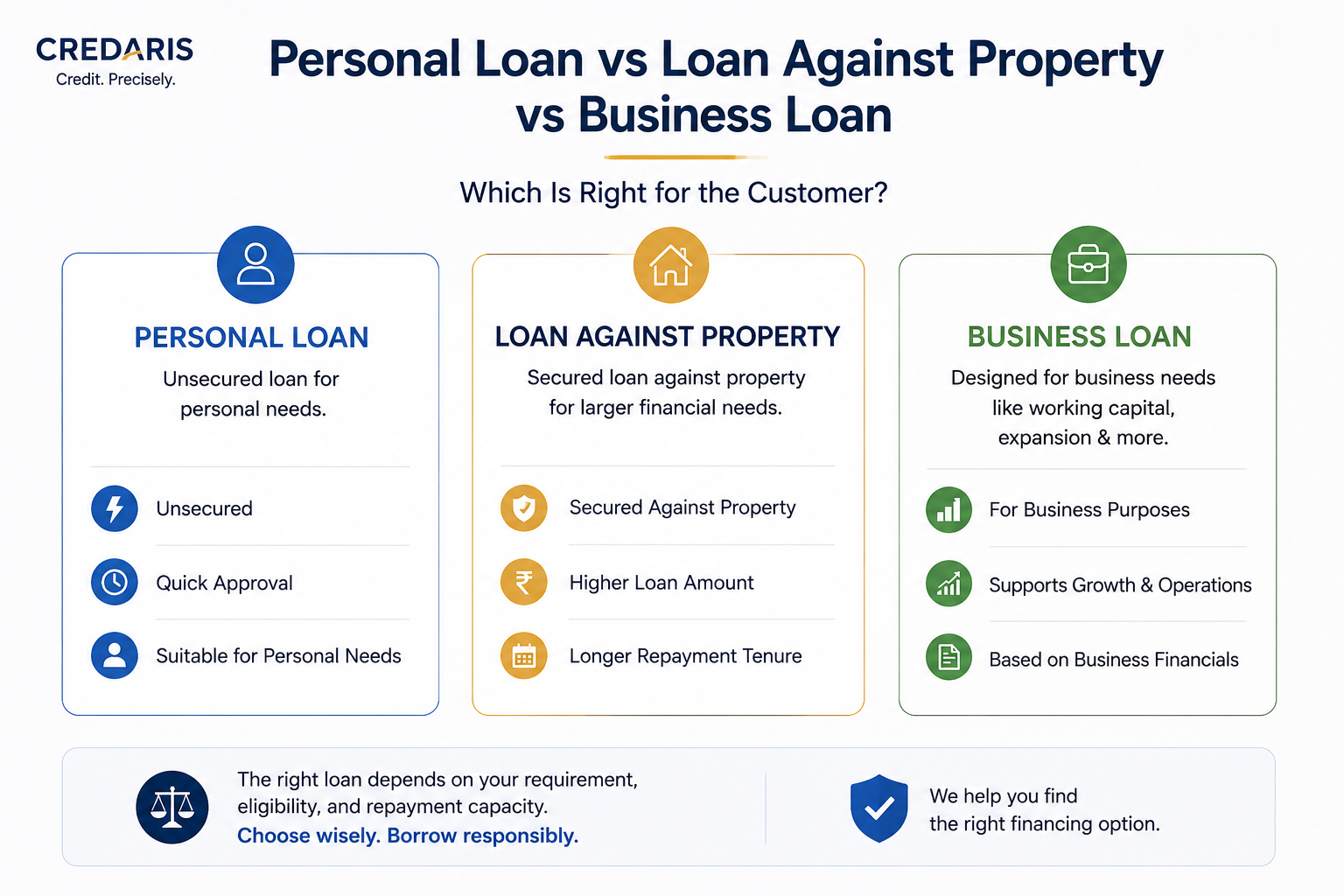
Credaris Insights
Personal Loan vs Loan Against Property vs Business Loan: Which Is Right for the Customer?
Choosing the right loan is not simply about finding the lowest interest rate or the highest available loan amount. Every customer has a different financial situation, borrowing requirement, income profile, and repayment capacity.
A salaried professional may need funds for a personal expense, a property owner may require substantial financing against an asset, while a business owner may need working capital or funds for expansion.
For loan advisors, understanding these differences is essential. The right recommendation should be based on the customer's purpose, income, existing obligations, credit profile, repayment capacity, and available collateral.
Three commonly considered financing options are Personal Loans, Loans Against Property, and Business Loans. Let's understand how they differ and when each may be suitable.
1. Personal Loan
A personal loan is generally an unsecured form of borrowing, meaning the customer typically does not need to provide property as collateral.
Personal loans can be used for various personal financial requirements, subject to the lender's terms and conditions. These may include medical expenses, education, weddings, travel, home-related expenses, debt consolidation, or other personal needs.
Personal loans may be suitable for customers who have a stable income, an acceptable credit profile, and a requirement for funds without pledging an asset.
The eligibility, loan amount, interest rate, and tenure depend on the lender and the customer's overall financial profile.
2. Loan Against Property
A Loan Against Property, commonly known as LAP, is a secured loan where the customer offers an eligible property as collateral to the lender.
Because the loan is secured against an asset, it can be considered for customers who require a relatively larger amount of funding and have suitable property available.
Depending on the lender and customer profile, LAP may be used for personal or business-related requirements.
However, customers should understand that the property is being offered as security for the loan. Repayment obligations must therefore be managed responsibly.
3. Business Loan
A business loan is primarily designed to meet business-related financial requirements.
Businesses may require financing for working capital, expansion, equipment purchases, inventory, renovation, business operations, or opening a new location.
Eligibility can depend on factors such as business vintage, turnover, profitability, banking behaviour, credit history, and financial documentation.
Business loans may be suitable for established business owners, self-employed professionals, entrepreneurs, and other eligible applicants who have a genuine business funding requirement.
4. What Is the Main Difference Between These Loans?
The biggest difference is the purpose, structure, and requirements associated with each product.
A personal loan is generally unsecured and designed for personal financial requirements.
A Loan Against Property is secured against eligible property and can potentially support larger funding requirements.
A business loan is primarily designed to finance business-related expenses and may involve a detailed assessment of the business's financial health.
The right choice depends on the individual customer's circumstances rather than simply choosing the product with the lowest advertised rate.
5. How Should a Loan Advisor Choose the Right Product?
A good loan advisor should not begin the conversation by trying to sell a specific loan product.
The first step should be understanding the customer's actual requirement.
The advisor should ask what the funds are required for, how much is needed, what the customer's income looks like, what existing obligations they have, and how they intend to repay the loan.
Once these factors are understood, the advisor can evaluate which financing options may be appropriate.
6. Start With the Purpose of the Loan
The purpose of borrowing is one of the most important factors.
If a customer requires funds for a personal expense, a personal loan may be worth considering.
If the requirement is related to business operations or expansion, a business loan may be more appropriate.
If the customer owns eligible property and requires a larger amount of funding, a Loan Against Property may also be an option, depending on the lender's policies.
Understanding the purpose first prevents advisors from recommending a product that does not align with the customer's actual requirement.
7. Consider the Required Loan Amount
The amount required can also influence the choice of product.
A customer looking for a relatively small amount may prefer an unsecured product if they meet the eligibility criteria.
For larger requirements, secured financing such as LAP may potentially be considered, particularly when the customer has suitable property available.
However, advisors should focus on the amount the customer actually needs rather than encouraging them to borrow the maximum amount they are eligible for.
8. Evaluate Repayment Capacity
A customer qualifying for a loan does not necessarily mean that the loan is financially comfortable for them.
Advisors should consider the customer's monthly income, existing EMIs, other financial obligations, proposed EMI, and overall repayment capacity.
FOIR can also be used as one of the factors to understand how much of the customer's income may be committed towards existing and proposed obligations.
The objective should be to recommend financing that the customer can reasonably manage.
9. Check the Customer's Credit Profile
Credit history is important across different loan products.
Advisors should understand the customer's credit score, repayment history, existing loans, outstanding obligations, and recent credit enquiries.
A strong credit history can support loan eligibility, while negative repayment behaviour may make approval more challenging.
However, credit score requirements vary between lenders, so advisors should avoid assuming that one particular score guarantees approval.
10. Consider Whether Collateral Is Available
Collateral can significantly influence the type of financing available to a customer.
A customer who does not want to pledge property may prefer an unsecured option, provided they meet the lender's criteria.
A customer who owns eligible property and requires substantial funding may consider a Loan Against Property.
When discussing secured loans, advisors should clearly explain the implications of pledging an asset as collateral.
11. Evaluate Business Financials
When considering a business loan, the advisor should understand the financial health of the business.
This may involve reviewing business vintage, turnover, profitability, banking transactions, Income Tax Returns, GST records, and existing liabilities.
A proper assessment can help determine whether the customer's business requirement and financial profile are suitable for the product.
12. When a Personal Loan May Be Suitable
A personal loan may be worth considering when the customer needs flexible funding for a personal requirement, has a stable income and acceptable credit profile, and does not want to pledge property as collateral.
However, the customer should still compare the overall borrowing cost, EMI, tenure, processing fees, and other applicable charges before proceeding.
13. When a Loan Against Property May Be Suitable
A Loan Against Property may be considered when the customer requires a larger amount of financing and owns an eligible property that can be offered as security.
The product may also be considered when the customer is comfortable with a secured borrowing structure and requires a potentially longer repayment period.
Because property is involved as collateral, the advisor should make sure the customer understands the loan terms and repayment obligations clearly.
14. When a Business Loan May Be Suitable
A business loan may be appropriate when the customer requires funding for business purposes and has an eligible business profile.
The funds may be used for working capital, expansion, equipment, inventory, or other business requirements, depending on the product.
The advisor should evaluate the business's income, financial records, banking behaviour, existing liabilities, and overall repayment capacity before recommending an option.
15. Common Mistakes Loan Advisors Should Avoid
One common mistake is recommending a loan purely because it has a lower advertised interest rate. The overall cost, tenure, fees, eligibility, and customer's requirements should also be considered.
Another mistake is focusing only on the maximum loan amount available. Just because a customer qualifies for a particular amount does not mean that borrowing the maximum is financially appropriate.
Advisors should also avoid ignoring the purpose of the loan or failing to explain the risks associated with secured borrowing.
Most importantly, advisors should never guarantee loan approval before the lender has completed its assessment.
16. A Simple Framework for Loan Advisors
A simple approach can help advisors structure their customer conversations:
Requirement ? Income ? Existing Obligations ? Credit Profile ? Collateral ? Loan Amount ? Repayment Capacity ? Suitable Product
Following this process allows advisors to focus on the customer's actual financial requirement instead of simply trying to sell a particular product.
17. Conclusion
Personal Loans, Loans Against Property, and Business Loans serve different financial requirements.
A personal loan may be suitable for customers looking for unsecured funding for personal needs. A Loan Against Property may be worth considering for customers with eligible property who require larger financing. A business loan can be appropriate for customers seeking funds for business-related purposes.
There is no single loan product that is best for every customer.
The role of a good loan advisor is to understand the customer's requirement, evaluate their financial profile, explain the available options, and help them make an informed decision.
The right loan is not necessarily the biggest loan or the one with the lowest advertised interest rate. It is the loan that fits the customer's requirement and repayment capacity.
Frequently Asked Questions
1. Which is better, a personal loan or a Loan Against Property?
Neither is universally better. The appropriate option depends on the customer's funding requirement, repayment capacity, credit profile, and whether they are willing and able to provide eligible property as collateral.
2. Is a Loan Against Property secured?
Yes. A Loan Against Property is generally secured against eligible property offered by the borrower.
3. Can a business owner take a personal loan?
A business owner may be eligible for a personal loan depending on the lender's criteria, income assessment, credit profile, and other requirements.
4. What is the main difference between a personal loan and a business loan?
A personal loan is generally intended for personal financial requirements, while a business loan is primarily designed for business-related expenses.
5. Which loan is suitable for a large funding requirement?
For larger funding requirements, secured financing such as a Loan Against Property may be an option for eligible customers. However, the appropriate product depends on the customer's complete financial profile and the lender's criteria.
6. Should loan advisors recommend the loan with the lowest interest rate?
Not necessarily. Advisors should consider the customer's requirement, eligibility, total borrowing cost, tenure, fees, repayment capacity, and other terms before recommending a product.
Choosing the right loan is not simply about finding the lowest interest rate or the highest available loan amount. Every customer has a different financial situation, borrowing requirement, income profile, and repayment capacity.
A salaried professional may need funds for a personal expense, a property owner may require substantial financing against an asset, while a business owner may need working capital or funds for expansion.
For loan advisors, understanding these differences is essential. The right recommendation should be based on the customer's purpose, income, existing obligations, credit profile, repayment capacity, and available collateral.
Three commonly considered financing options are Personal Loans, Loans Against Property, and Business Loans. Let's understand how they differ and when each may be suitable.
1. Personal Loan
A personal loan is generally an unsecured form of borrowing, meaning the customer typically does not need to provide property as collateral.
Personal loans can be used for various personal financial requirements, subject to the lender's terms and conditions. These may include medical expenses, education, weddings, travel, home-related expenses, debt consolidation, or other personal needs.
Personal loans may be suitable for customers who have a stable income, an acceptable credit profile, and a requirement for funds without pledging an asset.
The eligibility, loan amount, interest rate, and tenure depend on the lender and the customer's overall financial profile.
2. Loan Against Property
A Loan Against Property, commonly known as LAP, is a secured loan where the customer offers an eligible property as collateral to the lender.
Because the loan is secured against an asset, it can be considered for customers who require a relatively larger amount of funding and have suitable property available.
Depending on the lender and customer profile, LAP may be used for personal or business-related requirements.
However, customers should understand that the property is being offered as security for the loan. Repayment obligations must therefore be managed responsibly.
3. Business Loan
A business loan is primarily designed to meet business-related financial requirements.
Businesses may require financing for working capital, expansion, equipment purchases, inventory, renovation, business operations, or opening a new location.
Eligibility can depend on factors such as business vintage, turnover, profitability, banking behaviour, credit history, and financial documentation.
Business loans may be suitable for established business owners, self-employed professionals, entrepreneurs, and other eligible applicants who have a genuine business funding requirement.
4. What Is the Main Difference Between These Loans?
The biggest difference is the purpose, structure, and requirements associated with each product.
A personal loan is generally unsecured and designed for personal financial requirements.
A Loan Against Property is secured against eligible property and can potentially support larger funding requirements.
A business loan is primarily designed to finance business-related expenses and may involve a detailed assessment of the business's financial health.
The right choice depends on the individual customer's circumstances rather than simply choosing the product with the lowest advertised rate.
5. How Should a Loan Advisor Choose the Right Product?
A good loan advisor should not begin the conversation by trying to sell a specific loan product.
The first step should be understanding the customer's actual requirement.
The advisor should ask what the funds are required for, how much is needed, what the customer's income looks like, what existing obligations they have, and how they intend to repay the loan.
Once these factors are understood, the advisor can evaluate which financing options may be appropriate.
6. Start With the Purpose of the Loan
The purpose of borrowing is one of the most important factors.
If a customer requires funds for a personal expense, a personal loan may be worth considering.
If the requirement is related to business operations or expansion, a business loan may be more appropriate.
If the customer owns eligible property and requires a larger amount of funding, a Loan Against Property may also be an option, depending on the lender's policies.
Understanding the purpose first prevents advisors from recommending a product that does not align with the customer's actual requirement.
7. Consider the Required Loan Amount
The amount required can also influence the choice of product.
A customer looking for a relatively small amount may prefer an unsecured product if they meet the eligibility criteria.
For larger requirements, secured financing such as LAP may potentially be considered, particularly when the customer has suitable property available.
However, advisors should focus on the amount the customer actually needs rather than encouraging them to borrow the maximum amount they are eligible for.
8. Evaluate Repayment Capacity
A customer qualifying for a loan does not necessarily mean that the loan is financially comfortable for them.
Advisors should consider the customer's monthly income, existing EMIs, other financial obligations, proposed EMI, and overall repayment capacity.
FOIR can also be used as one of the factors to understand how much of the customer's income may be committed towards existing and proposed obligations.
The objective should be to recommend financing that the customer can reasonably manage.
9. Check the Customer's Credit Profile
Credit history is important across different loan products.
Advisors should understand the customer's credit score, repayment history, existing loans, outstanding obligations, and recent credit enquiries.
A strong credit history can support loan eligibility, while negative repayment behaviour may make approval more challenging.
However, credit score requirements vary between lenders, so advisors should avoid assuming that one particular score guarantees approval.
10. Consider Whether Collateral Is Available
Collateral can significantly influence the type of financing available to a customer.
A customer who does not want to pledge property may prefer an unsecured option, provided they meet the lender's criteria.
A customer who owns eligible property and requires substantial funding may consider a Loan Against Property.
When discussing secured loans, advisors should clearly explain the implications of pledging an asset as collateral.
11. Evaluate Business Financials
When considering a business loan, the advisor should understand the financial health of the business.
This may involve reviewing business vintage, turnover, profitability, banking transactions, Income Tax Returns, GST records, and existing liabilities.
A proper assessment can help determine whether the customer's business requirement and financial profile are suitable for the product.
12. When a Personal Loan May Be Suitable
A personal loan may be worth considering when the customer needs flexible funding for a personal requirement, has a stable income and acceptable credit profile, and does not want to pledge property as collateral.
However, the customer should still compare the overall borrowing cost, EMI, tenure, processing fees, and other applicable charges before proceeding.
13. When a Loan Against Property May Be Suitable
A Loan Against Property may be considered when the customer requires a larger amount of financing and owns an eligible property that can be offered as security.
The product may also be considered when the customer is comfortable with a secured borrowing structure and requires a potentially longer repayment period.
Because property is involved as collateral, the advisor should make sure the customer understands the loan terms and repayment obligations clearly.
14. When a Business Loan May Be Suitable
A business loan may be appropriate when the customer requires funding for business purposes and has an eligible business profile.
The funds may be used for working capital, expansion, equipment, inventory, or other business requirements, depending on the product.
The advisor should evaluate the business's income, financial records, banking behaviour, existing liabilities, and overall repayment capacity before recommending an option.
15. Common Mistakes Loan Advisors Should Avoid
One common mistake is recommending a loan purely because it has a lower advertised interest rate. The overall cost, tenure, fees, eligibility, and customer's requirements should also be considered.
Another mistake is focusing only on the maximum loan amount available. Just because a customer qualifies for a particular amount does not mean that borrowing the maximum is financially appropriate.
Advisors should also avoid ignoring the purpose of the loan or failing to explain the risks associated with secured borrowing.
Most importantly, advisors should never guarantee loan approval before the lender has completed its assessment.
16. A Simple Framework for Loan Advisors
A simple approach can help advisors structure their customer conversations:
Requirement ? Income ? Existing Obligations ? Credit Profile ? Collateral ? Loan Amount ? Repayment Capacity ? Suitable Product
Following this process allows advisors to focus on the customer's actual financial requirement instead of simply trying to sell a particular product.
17. Conclusion
Personal Loans, Loans Against Property, and Business Loans serve different financial requirements.
A personal loan may be suitable for customers looking for unsecured funding for personal needs. A Loan Against Property may be worth considering for customers with eligible property who require larger financing. A business loan can be appropriate for customers seeking funds for business-related purposes.
There is no single loan product that is best for every customer.
The role of a good loan advisor is to understand the customer's requirement, evaluate their financial profile, explain the available options, and help them make an informed decision.
The right loan is not necessarily the biggest loan or the one with the lowest advertised interest rate. It is the loan that fits the customer's requirement and repayment capacity.
Frequently Asked Questions
1. Which is better, a personal loan or a Loan Against Property?
Neither is universally better. The appropriate option depends on the customer's funding requirement, repayment capacity, credit profile, and whether they are willing and able to provide eligible property as collateral.
2. Is a Loan Against Property secured?
Yes. A Loan Against Property is generally secured against eligible property offered by the borrower.
3. Can a business owner take a personal loan?
A business owner may be eligible for a personal loan depending on the lender's criteria, income assessment, credit profile, and other requirements.
4. What is the main difference between a personal loan and a business loan?
A personal loan is generally intended for personal financial requirements, while a business loan is primarily designed for business-related expenses.
5. Which loan is suitable for a large funding requirement?
For larger funding requirements, secured financing such as a Loan Against Property may be an option for eligible customers. However, the appropriate product depends on the customer's complete financial profile and the lender's criteria.
6. Should loan advisors recommend the loan with the lowest interest rate?
Not necessarily. Advisors should consider the customer's requirement, eligibility, total borrowing cost, tenure, fees, repayment capacity, and other terms before recommending a product.
Share
Insights for regulated credit and distribution teams.