Credit & Loan Advisory
CIBIL Score Explained: What Loan Advisors Should Tell Their Customers
September 9, 2026 · ~9 min read
A CIBIL Score is an important part of a customer's credit profile, but it is not the only factor lenders consider. Learn what loan advisors should know about CIBIL Scores and how to explain them to customers.
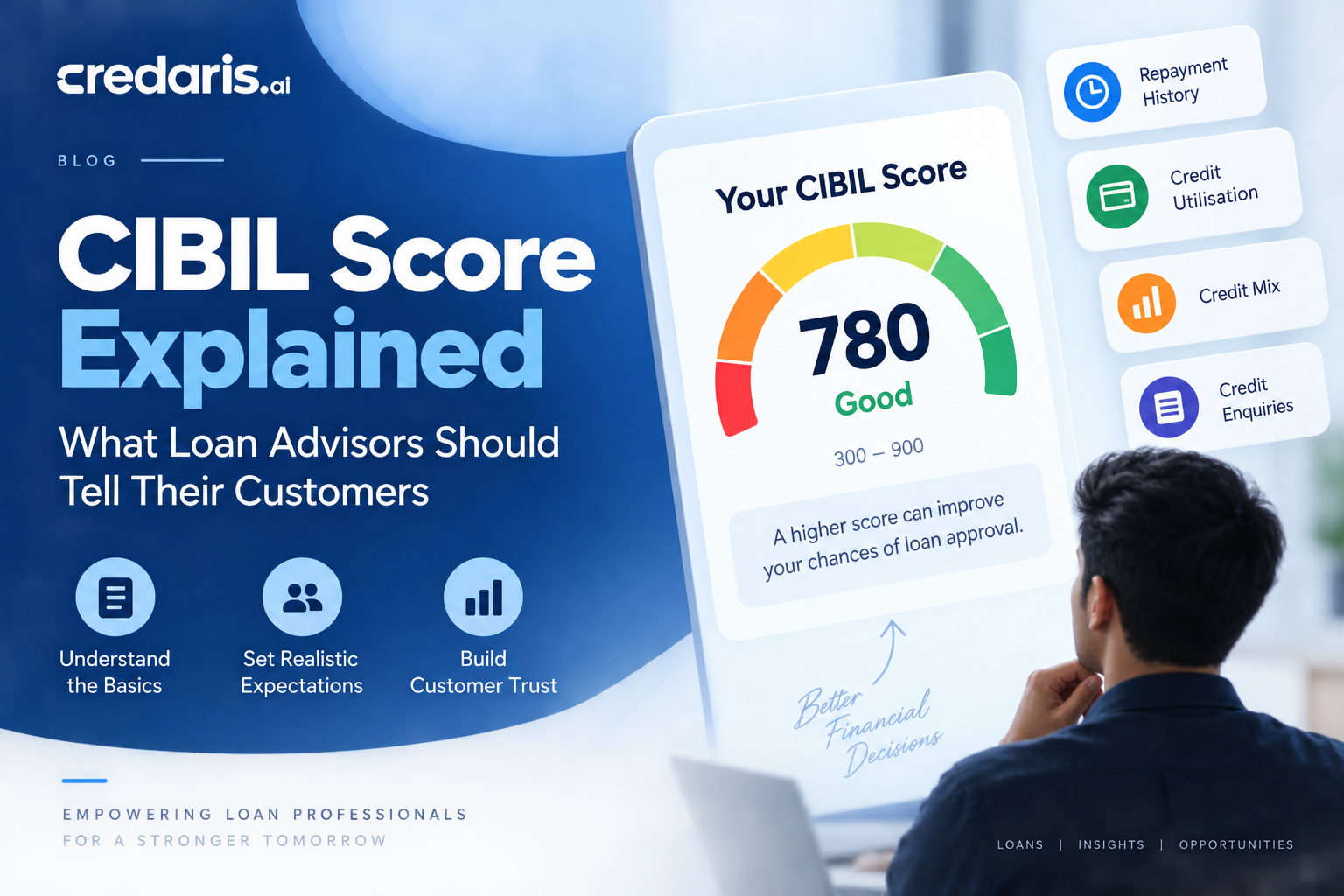
Credaris Insights
When customers apply for a loan, one of the first things they often hear about is their CIBIL Score.
Some customers believe that having a high score automatically guarantees loan approval. Others may not know what their score means or how their previous financial behaviour has affected it.
For loan advisors, understanding the CIBIL Score is important because it helps them have better conversations with customers and set realistic expectations before a loan application is submitted.
A credit score is an important part of the lending process, but it is only one part of the overall assessment.
1. What Is a CIBIL Score?
A CIBIL Score is a three-digit numerical representation of a customer's credit history.
In India, credit information is maintained by credit information companies, including TransUnion CIBIL. Lenders can use credit information and scores as part of their assessment when evaluating a customer's creditworthiness.
The score generally ranges from 300 to 900.
A higher score generally indicates a stronger credit history, while a lower score can indicate greater credit risk.
However, lenders do not rely on the score alone when making lending decisions.
2. Why Does CIBIL Score Matter for Loans?
When a lender receives a loan application, it wants to understand the customer's history of managing credit.
A credit report can provide information about previous and existing credit accounts, repayment behaviour, outstanding balances, and credit enquiries.
This information can help lenders assess the customer's credit behaviour alongside other factors such as income, employment, existing obligations, and repayment capacity.
For loan advisors, checking the customer's credit profile early can help identify potential issues before submitting an application.
3. What Does a CIBIL Score Tell a Lender?
A CIBIL Score gives lenders an indication of a customer's credit behaviour.
A strong credit profile may suggest that the customer has historically managed credit responsibly.
A weaker profile may require additional assessment depending on the lender's policies.
However, the score should not be interpreted in isolation.
Two customers with similar scores can have completely different income levels, loan obligations, employment profiles, and financial circumstances.
4. What Factors Can Affect a CIBIL Score?
Several aspects of a customer's credit behaviour can influence their credit profile.
Repayment History
Regular and timely repayment of loans and credit card bills is important. Missed or delayed payments can negatively affect a customer's credit history.
Credit Utilisation
Using a large portion of the available credit limit can influence the customer's credit profile. Maintaining responsible credit utilisation is generally considered healthier than consistently using most of the available limit.
Credit Mix
A customer's profile may include different types of credit, such as secured and unsecured loans. The overall credit mix can form part of the credit assessment.
Length of Credit History
A longer, well-managed credit history can provide lenders with more information about a customer's borrowing behaviour.
Recent Credit Enquiries
Applying for multiple credit products within a short period can result in multiple credit enquiries. Frequent applications may be considered as part of the overall credit assessment.
5. What Is Considered a Good CIBIL Score?
There is no universal score that guarantees loan approval.
In general, a score closer to the upper end of the 300 to 900 range is viewed more favourably by many lenders.
However, each lender can have its own credit policies and minimum requirements.
A customer should therefore not assume that a particular score automatically means approval or rejection.
The lender's complete assessment remains important.
6. Does a Low CIBIL Score Mean a Customer Cannot Get a Loan?
Not necessarily.
A low score can make borrowing more difficult, but the final decision depends on the lender's assessment and the customer's complete financial profile.
Factors such as income, employment stability, existing obligations, loan type, collateral, business performance, and lender-specific policies can also influence eligibility.
For advisors, it is better to explain this honestly rather than immediately telling a customer that a low score makes a loan impossible.
7. Why Customers May Have a Low CIBIL Score
There can be several reasons behind a weaker credit profile.
A customer may have missed EMI payments, delayed credit card payments, maintained high outstanding balances, experienced a past financial difficulty, or made several credit applications within a short period.
In some cases, customers may also discover errors or outdated information in their credit report.
This is why advisors should encourage customers to understand their credit report instead of focusing only on the final score.
8. What Should Customers Check in Their Credit Report?
Customers should review their credit report carefully for accuracy.
They can check whether their personal information is correct and whether the listed loan and credit card accounts actually belong to them.
They should also look at repayment information, outstanding balances, account status, and recent credit enquiries.
If a customer notices incorrect information, they should raise the issue through the appropriate credit bureau or lender process.
9. How Can Customers Improve Their Credit Profile?
Improving a credit profile generally requires consistent financial behaviour over time.
Customers should focus on making loan and credit card payments on time.
They should also avoid taking on unnecessary debt and should manage their available credit responsibly.
Customers should be careful about applying for multiple loans or credit cards without a genuine requirement.
Most importantly, improving a credit profile is not usually an overnight process. Consistent repayment behaviour matters over time.
10. CIBIL Score vs Loan Eligibility
A common misunderstanding is that the CIBIL Score determines loan eligibility by itself.
In reality, lenders can consider multiple factors.
For example, a customer may have a strong CIBIL Score but already have significant existing EMIs.
Another customer may have a moderate score but stable income, manageable obligations, and a strong overall financial profile.
This is why loan advisors should look at the complete customer profile rather than focusing on one number.
11. CIBIL Score and FOIR Work Differently
CIBIL Score and FOIR measure different aspects of a customer's financial profile.
CIBIL Score focuses primarily on credit history and credit behaviour.
FOIR helps assess how much of the customer's income is committed towards existing and proposed financial obligations.
A customer could have a strong CIBIL Score but a high FOIR.
Similarly, a customer could have manageable obligations but a weaker credit history.
Understanding both concepts helps advisors assess customers more effectively.
12. How Loan Advisors Should Explain CIBIL Score
Loan advisors should avoid using complicated financial terminology when explaining credit scores to customers.
A simple explanation could be:
"Your CIBIL Score gives lenders an idea of how you have managed credit in the past. It is important, but the lender will also look at your income, existing EMIs, employment or business profile, documentation, and other factors before making a decision."
This explanation gives customers a realistic understanding of what their score means.
13. Common CIBIL Misconceptions Loan Advisors Should Correct
One common misconception is that a perfect CIBIL Score guarantees loan approval.
It does not.
Another misconception is that checking your own credit report automatically damages your score. Customers should distinguish between checking their own report and credit enquiries made by lenders during applications.
Some customers also believe that closing every existing credit account will automatically improve their score. The impact of closing an account depends on the customer's overall credit profile and circumstances.
Advisors should therefore avoid making absolute claims about credit scores.
14. Should Customers Apply to Multiple Lenders?
Customers should avoid submitting unnecessary loan applications to multiple lenders at the same time.
Each lender may conduct its own credit assessment, and multiple recent credit enquiries can become part of the customer's credit history.
Instead, customers should first understand their eligibility and identify potentially suitable lending options.
This is where an experienced loan advisor can add value by helping customers approach relevant lenders rather than applying randomly.
15. How Loan Advisors Can Use Credit Information Better
A loan advisor can use credit information as an early assessment tool.
Before recommending a product, the advisor can understand the customer's credit profile, income, existing obligations, loan requirement, and employment or business situation.
This can help the advisor identify potential challenges early.
It can also help create more realistic conversations with customers about their available options.
The objective should not be to find a way around a customer's credit profile. It should be to understand the profile properly and identify suitable financing options based on the lender's criteria.
16. Why Credit Education Builds Customer Trust
Customers are more likely to trust advisors who explain both the opportunities and limitations of borrowing.
Instead of simply saying:
"Your CIBIL Score is good, so your loan will be approved."
an advisor can explain:
"Your credit profile looks positive based on the available information, but the final decision will depend on the lender's complete assessment."
This type of communication is more transparent and helps customers understand how lending decisions actually work.
17. Conclusion
A CIBIL Score is an important part of a customer's credit profile, but it is not the only factor that determines loan eligibility.
Loan advisors should understand how credit history, repayment behaviour, credit utilisation, enquiries, income, existing obligations, and other financial factors work together.
The role of an advisor is not simply to check a score. It is to understand the customer's complete financial profile and guide them towards appropriate lending options.
A CIBIL Score is a number, but a customer's complete financial profile tells the bigger story.
Frequently Asked Questions
What is a CIBIL Score?
A CIBIL Score is a three-digit score that represents aspects of a customer's credit history and credit behaviour. It generally ranges from 300 to 900.
What is a good CIBIL Score for a loan?
There is no single score that guarantees approval. Lenders have their own eligibility criteria and consider multiple aspects of a customer's financial profile.
Does a low CIBIL Score mean loan rejection?
Not necessarily. A low score can make approval more difficult, but lenders may consider income, existing obligations, employment, collateral, loan type, and other factors.
Does checking your own CIBIL report reduce your score?
A customer checking their own credit report is different from a lender making a credit enquiry during a loan application. Customers should understand the distinction between the two.
How can a customer improve their CIBIL Score?
Consistently paying EMIs and credit card bills on time, managing outstanding balances responsibly, avoiding unnecessary credit applications, and maintaining healthy credit behaviour can help improve a credit profile over time.
Is CIBIL Score the same as FOIR?
No. CIBIL Score relates primarily to credit history and behaviour, while FOIR focuses on the customer's income and fixed financial obligations.
Some customers believe that having a high score automatically guarantees loan approval. Others may not know what their score means or how their previous financial behaviour has affected it.
For loan advisors, understanding the CIBIL Score is important because it helps them have better conversations with customers and set realistic expectations before a loan application is submitted.
A credit score is an important part of the lending process, but it is only one part of the overall assessment.
1. What Is a CIBIL Score?
A CIBIL Score is a three-digit numerical representation of a customer's credit history.
In India, credit information is maintained by credit information companies, including TransUnion CIBIL. Lenders can use credit information and scores as part of their assessment when evaluating a customer's creditworthiness.
The score generally ranges from 300 to 900.
A higher score generally indicates a stronger credit history, while a lower score can indicate greater credit risk.
However, lenders do not rely on the score alone when making lending decisions.
2. Why Does CIBIL Score Matter for Loans?
When a lender receives a loan application, it wants to understand the customer's history of managing credit.
A credit report can provide information about previous and existing credit accounts, repayment behaviour, outstanding balances, and credit enquiries.
This information can help lenders assess the customer's credit behaviour alongside other factors such as income, employment, existing obligations, and repayment capacity.
For loan advisors, checking the customer's credit profile early can help identify potential issues before submitting an application.
3. What Does a CIBIL Score Tell a Lender?
A CIBIL Score gives lenders an indication of a customer's credit behaviour.
A strong credit profile may suggest that the customer has historically managed credit responsibly.
A weaker profile may require additional assessment depending on the lender's policies.
However, the score should not be interpreted in isolation.
Two customers with similar scores can have completely different income levels, loan obligations, employment profiles, and financial circumstances.
4. What Factors Can Affect a CIBIL Score?
Several aspects of a customer's credit behaviour can influence their credit profile.
Repayment History
Regular and timely repayment of loans and credit card bills is important. Missed or delayed payments can negatively affect a customer's credit history.
Credit Utilisation
Using a large portion of the available credit limit can influence the customer's credit profile. Maintaining responsible credit utilisation is generally considered healthier than consistently using most of the available limit.
Credit Mix
A customer's profile may include different types of credit, such as secured and unsecured loans. The overall credit mix can form part of the credit assessment.
Length of Credit History
A longer, well-managed credit history can provide lenders with more information about a customer's borrowing behaviour.
Recent Credit Enquiries
Applying for multiple credit products within a short period can result in multiple credit enquiries. Frequent applications may be considered as part of the overall credit assessment.
5. What Is Considered a Good CIBIL Score?
There is no universal score that guarantees loan approval.
In general, a score closer to the upper end of the 300 to 900 range is viewed more favourably by many lenders.
However, each lender can have its own credit policies and minimum requirements.
A customer should therefore not assume that a particular score automatically means approval or rejection.
The lender's complete assessment remains important.
6. Does a Low CIBIL Score Mean a Customer Cannot Get a Loan?
Not necessarily.
A low score can make borrowing more difficult, but the final decision depends on the lender's assessment and the customer's complete financial profile.
Factors such as income, employment stability, existing obligations, loan type, collateral, business performance, and lender-specific policies can also influence eligibility.
For advisors, it is better to explain this honestly rather than immediately telling a customer that a low score makes a loan impossible.
7. Why Customers May Have a Low CIBIL Score
There can be several reasons behind a weaker credit profile.
A customer may have missed EMI payments, delayed credit card payments, maintained high outstanding balances, experienced a past financial difficulty, or made several credit applications within a short period.
In some cases, customers may also discover errors or outdated information in their credit report.
This is why advisors should encourage customers to understand their credit report instead of focusing only on the final score.
8. What Should Customers Check in Their Credit Report?
Customers should review their credit report carefully for accuracy.
They can check whether their personal information is correct and whether the listed loan and credit card accounts actually belong to them.
They should also look at repayment information, outstanding balances, account status, and recent credit enquiries.
If a customer notices incorrect information, they should raise the issue through the appropriate credit bureau or lender process.
9. How Can Customers Improve Their Credit Profile?
Improving a credit profile generally requires consistent financial behaviour over time.
Customers should focus on making loan and credit card payments on time.
They should also avoid taking on unnecessary debt and should manage their available credit responsibly.
Customers should be careful about applying for multiple loans or credit cards without a genuine requirement.
Most importantly, improving a credit profile is not usually an overnight process. Consistent repayment behaviour matters over time.
10. CIBIL Score vs Loan Eligibility
A common misunderstanding is that the CIBIL Score determines loan eligibility by itself.
In reality, lenders can consider multiple factors.
For example, a customer may have a strong CIBIL Score but already have significant existing EMIs.
Another customer may have a moderate score but stable income, manageable obligations, and a strong overall financial profile.
This is why loan advisors should look at the complete customer profile rather than focusing on one number.
11. CIBIL Score and FOIR Work Differently
CIBIL Score and FOIR measure different aspects of a customer's financial profile.
CIBIL Score focuses primarily on credit history and credit behaviour.
FOIR helps assess how much of the customer's income is committed towards existing and proposed financial obligations.
A customer could have a strong CIBIL Score but a high FOIR.
Similarly, a customer could have manageable obligations but a weaker credit history.
Understanding both concepts helps advisors assess customers more effectively.
12. How Loan Advisors Should Explain CIBIL Score
Loan advisors should avoid using complicated financial terminology when explaining credit scores to customers.
A simple explanation could be:
"Your CIBIL Score gives lenders an idea of how you have managed credit in the past. It is important, but the lender will also look at your income, existing EMIs, employment or business profile, documentation, and other factors before making a decision."
This explanation gives customers a realistic understanding of what their score means.
13. Common CIBIL Misconceptions Loan Advisors Should Correct
One common misconception is that a perfect CIBIL Score guarantees loan approval.
It does not.
Another misconception is that checking your own credit report automatically damages your score. Customers should distinguish between checking their own report and credit enquiries made by lenders during applications.
Some customers also believe that closing every existing credit account will automatically improve their score. The impact of closing an account depends on the customer's overall credit profile and circumstances.
Advisors should therefore avoid making absolute claims about credit scores.
14. Should Customers Apply to Multiple Lenders?
Customers should avoid submitting unnecessary loan applications to multiple lenders at the same time.
Each lender may conduct its own credit assessment, and multiple recent credit enquiries can become part of the customer's credit history.
Instead, customers should first understand their eligibility and identify potentially suitable lending options.
This is where an experienced loan advisor can add value by helping customers approach relevant lenders rather than applying randomly.
15. How Loan Advisors Can Use Credit Information Better
A loan advisor can use credit information as an early assessment tool.
Before recommending a product, the advisor can understand the customer's credit profile, income, existing obligations, loan requirement, and employment or business situation.
This can help the advisor identify potential challenges early.
It can also help create more realistic conversations with customers about their available options.
The objective should not be to find a way around a customer's credit profile. It should be to understand the profile properly and identify suitable financing options based on the lender's criteria.
16. Why Credit Education Builds Customer Trust
Customers are more likely to trust advisors who explain both the opportunities and limitations of borrowing.
Instead of simply saying:
"Your CIBIL Score is good, so your loan will be approved."
an advisor can explain:
"Your credit profile looks positive based on the available information, but the final decision will depend on the lender's complete assessment."
This type of communication is more transparent and helps customers understand how lending decisions actually work.
17. Conclusion
A CIBIL Score is an important part of a customer's credit profile, but it is not the only factor that determines loan eligibility.
Loan advisors should understand how credit history, repayment behaviour, credit utilisation, enquiries, income, existing obligations, and other financial factors work together.
The role of an advisor is not simply to check a score. It is to understand the customer's complete financial profile and guide them towards appropriate lending options.
A CIBIL Score is a number, but a customer's complete financial profile tells the bigger story.
Frequently Asked Questions
What is a CIBIL Score?
A CIBIL Score is a three-digit score that represents aspects of a customer's credit history and credit behaviour. It generally ranges from 300 to 900.
What is a good CIBIL Score for a loan?
There is no single score that guarantees approval. Lenders have their own eligibility criteria and consider multiple aspects of a customer's financial profile.
Does a low CIBIL Score mean loan rejection?
Not necessarily. A low score can make approval more difficult, but lenders may consider income, existing obligations, employment, collateral, loan type, and other factors.
Does checking your own CIBIL report reduce your score?
A customer checking their own credit report is different from a lender making a credit enquiry during a loan application. Customers should understand the distinction between the two.
How can a customer improve their CIBIL Score?
Consistently paying EMIs and credit card bills on time, managing outstanding balances responsibly, avoiding unnecessary credit applications, and maintaining healthy credit behaviour can help improve a credit profile over time.
Is CIBIL Score the same as FOIR?
No. CIBIL Score relates primarily to credit history and behaviour, while FOIR focuses on the customer's income and fixed financial obligations.
Share
Insights for regulated credit and distribution teams.